 比利時中非博物館一直是非洲生物研究的重鎮之一, 該館的鱗翅目研究者Jurate De Prins近來完成一個新的資料庫 - AfroMoths.Net, 收錄非洲大陸產蛾類的名錄與原始發表文獻記錄. 網址在此
2010年11月10日 星期三
AfroMoths.Net - 一個非洲蛾類資訊新網頁
比利時中非博物館一直是非洲生物研究的重鎮之一, 該館的鱗翅目研究者Jurate De Prins近來完成一個新的資料庫 - AfroMoths.Net, 收錄非洲大陸產蛾類的名錄與原始發表文獻記錄. 網址在此

2010年3月30日 星期二
同時使用形態與分子特徵對非洲產圓翅基蛾亞科(鞘蛾科)進行分類檢討
 文獻來源: Adamski, D., R. S. Copeland, S. E. Miller, P. D. N. Hebert, K. Darrow, and Q. Luke. 2010. A review of African Blastobasinae (Lepidoptera: Gelechioidea: Coleophoridae), with new taxa reared from native fruits in Kenya. Smithsonian Contributions to Zoology 630: vi + 68. [全文下載]
 Abstract
Twenty-five species of African Blastobasinae (Lepidoptera: Coleophoridae) are reviewed; 12 species are redescribed, and 13 species are described as new. Rearing of Lepidoptera ancillary to sampling efforts targeted for fruit flies (Diptera: Tephritidae) and their parasitoids was conducted in and near forested areas in coastal, central highland, and western highland habitats in Kenya. Reared moths were associated with fruits of 64 plant species in 34 families. Two new species, Blastobasis millicentae and Neoblastobasis perisella, were discovered in mixed original type series of species described by Meyrick and also reared from fruit. Eight new species, Blastobasis acirfa, B. aynekiella, B. chuka, B. elgonae, B. kenya, B. glauconotata, and Neoblastobasis ximeniaella, and N. wangithiae, are known only from specimens reared from fruit. One new species, Blastobasis catappaella, was reared from fruit and collected at black light. Finally, two new species, Neoblastobasis laikipiae and Blastobasis mpala, are known only from black light samples. DNA barcodes augmented the ability to discriminate between some closely related species within several genera. Male specimens of Blastobasis kenya, B. acirfa, and B. aynekiella and some associated female conspecifics, in particular, had distinctly different barcodes but were not initially diagnosed using standard morphological features. Subsequently, corroborative morphological features were found to support the DNA barcode data, and both data are discussed herein. Lectotypes are designated for Blastobasis arguta Meyrick, 1918; B. byrsodepta Meyrick, 1913; B. egens Meyrick, 1918; B. eridryas Meyrick, 1932; B. extensa Meyrick, 1918; B. indigesta Meyrick, 1931; B. industria Meyrick, 1913; and B. trachilista Meyrick, 1921. Zenodochium arguta Meyrick, 1918 is transferred to Calosima Dietz, 1910, new combination, and Tecmerium irroratella Walsingham, 1891 and Blastobasis extensa Meyrick, 1918 are transferred to Holcocera Clemens, 1863, new combinations. Neoblastobasis indigesta (Meyrick, 1931), revised status, is transferred to Blastobasis Zeller, 1855. Syndroma Meyrick is a junior synonym of Holcocera Clemens, 1863, and Syndroma lignyodes Meyrick, 1914 is transferred to Holcocera, new combination. The first African records for Holcocera, Calosima, and Neoblastobasis are reported. A key for all African Blastobasinae is included, together with photographs of the adults and illustrations of the male and female genitalia.
2010年3月11日 星期四
[新書]熱帶非洲地區非洲鹿蛾族(Thyretini)之圖錄
 [書名] Thyretini of Africa - An Illustrated Catalogue of the Thyretini (Lepidoptera: Arctiidae: Syntominae) of the Afrotropical Region
[作者] Lukasz Przybylowicz
[年代] 2009 (December)
[出版] Apollo Books
[ISBN] ISBN-10: 8788757919 ISBN-13: 978-8788757910
[網頁] http://www.apollobooks.com/thyretini.htm
2009年9月20日 星期日
非洲白鳳蝶的系統發生學與擬態翅紋的演化

 文獻出處:Clark, R. & Vogler, A. P. (2009) A phylogenetic framwork for wing pattern evolutio in the mimetic Mocker Swallowtail Papilio dardanus. Molecular Ecology 18: 3872-3884.
簡介
非洲白鳳蝶(Papilio dardanus)被認為是貝氏擬態(Batesian mimicry)中的擬態者(mimic),其雌雄二態性與雌性其中一型擬態大樺斑蝶(Danaus plexippus)的表型長久以來被視為擬態生物學中的經典例子之一。本篇文章嘗試利用分子資料重建非洲白鳳蝶不同亞種間與不同區域間的親緣關係,嘗試找出其擬態斑紋的演化時順。該研究使用兩個粒線體基因與數個與擬態斑紋有關或無關的核基因,重建不同亞種間的親緣關係。結果顯示粒線體基因在不同區域間呈現地理上的結構,並且有較少的多樣性;而核基因間則無地理上的結構,並且基因序列間有多樣性的情形。定年的結果顯示,非洲白鳳蝶的種化約發生於2.9百萬年前,而擬態斑紋族群的產生則在0.55-0.94百萬年前,擬態斑紋的產生在非洲白鳳蝶的原名亞種(P. d. dardanus)中是較早出現的,但仍晚於雌雄二態性。
Abstract
The Batesian mimetic swallowtail butterfly Papilio dardanus exhibits numerous distinct wing colour morphs whose evolutionary origins require large phenotypic shifts. A phylogenetic framework to study the history of these morphs was established by DNA sequencing of representative subspecies from sub-Saharan Africa and Indian Ocean islands. Two mitochondrial genes and the nuclear internal transcribed spacer marker revealed deeply separated eastern and western African mainland lineages, plus one lineage each on Madagascar and Grande Comore. These markers showed very little polymorphism within lineages. In contrast, markers genetically linked to the mimicry locus H, including the transcription factor invected and two adjacent amplified fragment length polymorphisms-derived sequences, showed high nucleotide diversity but were not geographically structured. Variation in the unlinked wingless gene showed a similar pattern, rejecting the hypothesis that high level of variation in the H region is due to balancing selection exerted by the phenotypes. The separation from a common ancestor with Papilio phorcas estimated at 2.9 Ma coincides with the origin of a mimicry model, Danaus chrysippus. However, the model reached Africa only at the time of the internal splits of P. dardanus mtDNA groups, here estimated at 0.55-0.94 Ma. The nuclear genome shows less geographic structure and may not track recent population differentiation, suggesting that widespread mimicry morphs have arisen early in the evolution of the P. dardanus lineage, although after the male-female dimorphism which is ancestral. The current wide distribution of P. dardanus and population subdivision evident from mtDNA may have been achieved only with the spread of the models across Africa.
2009年9月5日 星期六
再次遠離非洲:以五個基因建立螯蛺蝶屬的親緣關係假說


 Out-of-Africa again: A phylogenetic hypothesis of the genus Charaxes (Lepidoptera: Nymphalidae) based on five gene regions
文獻來源: Aduse-Poku K, Vingerhoedt E, Wahlberg N. 2009. Out-of-Africa again: A phylogenetic hypothesis of the genus Charaxes (Lepidoptera: Nymphalidae) based on five gene regions. Molecular Phylogenetics and Evolution 53 :463–478
雖然螯蛺蝶屬(Charaxes)長期在採集者與研究者之間受到歡迎,其演化歷史大多仍然未知。近期被接受的種群和屬內近緣種是專斷地以成蟲形態與生活史 為基礎,作者在本研究中以來自五個基因區域(1粒線體基因+4核基因)共 4167 bp序列資料檢驗螯蛺蝶屬內的單系性與演化上的親緣關係,並探討其近緣屬Euxanthe, Polyura(雙尾蝶屬)與 Palla之間的關係。在此提議的親緣關係架構中,作者評估屬級的分化年代並重建其歷史上的生物地理。作者採用包括所有非洲與亞洲的已知種群、所有已知的 Euxanthe與 Palla物種和兩個Polyura的代表種作為研究對象代表,研究結果發現螯蛺蝶屬(Charaxes)為一個駢系群、與Euxanthe 和Polyura有關聯,此結果和以往所認為的單系群假設相反。作者發現以形態定義的16個種群 (超過一個物種)中有13個為有強力支持的單系分支,Charaxes nichetes為其他Charaxes物種的姊妹群。 Polyura與Zoolina 和 Pleione 種群形成一個有良好支持度的支系,而Euxanthe則與Lycurgus 種群歸在一群。作者的結果指出Charaxes的共同祖先是在始新世中期(約4500萬年前)於非洲(中部)由Palla的共同祖先分化而來,並在1500萬年之後開始分化岀其他物種成員。此屬大部份的多樣性在漸新世晚期與中新世間、全球氣候發生強烈的波動時開始 增加。相當大量的衍生物種於上新世時從其姊妹種演化而來。播遷-割據分析推測在其衍生物種的分布過程中、播遷事件的發生多於割據事件。 Polyura與印澳區的Charaxes最可能是非洲的Charaxes於中新世在亞洲的三個獨立拓殖之結果。作者將以下兩屬處理為Charaxes的 同物異名:Polyura (syn. nov.)與Euxanthe (syn. nov.),並將新定義的 Charaxes劃分為五個亞屬以反應其親緣關係。
Abstract
Despite the long popularity of Charaxes among collectors and researchers, their evolutionary history is largely unknown. The current and accepted species groupings and relationships within the genus are based exclusively on adult morphology and life histories. Here, we examine the monophyly and evolutionary affinities of the species-groups within the genus Charaxes and explore how they relate to members of their closest genera (Euxanthe, Polyura and Palla) using 4167 bp of sequence data from five (1 mitochondrial and 4 nuclear) gene regions. Within the proposed phylogenetic framework, we estimate ages of divergence within the genus and also reconstruct their historical biogeography. We included representatives of all known species-groups in Africa and Asia, all known species of Euxanthe and Palla and two exemplar species of Polyura. We found the genus Charaxes to be a paraphyletic group with regard to the genera Polyura and Euxanthe, contrary to the earlier assumption of monophyly. We found that 13 out of 16 morphologically defined species-groups with more than one species were strongly supported monophyletic clades. Charaxes nichetes is the sister group to all the other Charaxes. Polyura grouped with the Zoolina and Pleione species-groups as a well-supported clade, and Euxanthe grouped with the Lycurgus species-group. Our results indicated that the common ancestor of Charaxes diverged from the common ancestor of Palla in the mid Eocene (45 million years ago) in (Central) Africa and began diversifying to its extant members 15 million years later. Most of the major diversifications within the genus occurred between the late Oligocene and Miocene when the global climates were putatively undergoing drastic fluctuations. A considerable number of extant species diverged from sister species during the Pliocene. A dispersal–vicariance analysis suggests that many dispersal rather than vicariance events resulted in the distribution of the extant species. The genus Polyura and the Indo-Australian Charaxes are most likely the results of three independent colonizations of Asia by African Charaxes in the Miocene. We synonymize the genera Polyura (syn. nov.) and Euxanthe (syn. nov.) with Charaxes, with the currently circumscribed Charaxes subdivided into five subgenera to reflect its phylogeny.
Despite the long popularity of Charaxes among collectors and researchers, their evolutionary history is largely unknown. The current and accepted species groupings and relationships within the genus are based exclusively on adult morphology and life histories. Here, we examine the monophyly and evolutionary affinities of the species-groups within the genus Charaxes and explore how they relate to members of their closest genera (Euxanthe, Polyura and Palla) using 4167 bp of sequence data from five (1 mitochondrial and 4 nuclear) gene regions. Within the proposed phylogenetic framework, we estimate ages of divergence within the genus and also reconstruct their historical biogeography. We included representatives of all known species-groups in Africa and Asia, all known species of Euxanthe and Palla and two exemplar species of Polyura. We found the genus Charaxes to be a paraphyletic group with regard to the genera Polyura and Euxanthe, contrary to the earlier assumption of monophyly. We found that 13 out of 16 morphologically defined species-groups with more than one species were strongly supported monophyletic clades. Charaxes nichetes is the sister group to all the other Charaxes. Polyura grouped with the Zoolina and Pleione species-groups as a well-supported clade, and Euxanthe grouped with the Lycurgus species-group. Our results indicated that the common ancestor of Charaxes diverged from the common ancestor of Palla in the mid Eocene (45 million years ago) in (Central) Africa and began diversifying to its extant members 15 million years later. Most of the major diversifications within the genus occurred between the late Oligocene and Miocene when the global climates were putatively undergoing drastic fluctuations. A considerable number of extant species diverged from sister species during the Pliocene. A dispersal–vicariance analysis suggests that many dispersal rather than vicariance events resulted in the distribution of the extant species. The genus Polyura and the Indo-Australian Charaxes are most likely the results of three independent colonizations of Asia by African Charaxes in the Miocene. We synonymize the genera Polyura (syn. nov.) and Euxanthe (syn. nov.) with Charaxes, with the currently circumscribed Charaxes subdivided into five subgenera to reflect its phylogeny.
2009年8月21日 星期五
共域分布但利用不同寄主植物的蝶類隱藏種群為異域起源


 文獻來源: McBride CS, Velzen RV & Larsen TB. 2009. Allopatric origin of cryptic butterfly species that were discovered feeding on distinct host plants in sympatry. Molecular Ecology 18(17): 3639-3651. [Abstract]
近年熱帶昆蟲的研究持續發現隱藏種-意指由於形態近似,過去被歸類為同一種,但其實具生殖隔離的不同物種。然而此類研究大多局限於單一地點,因此對於這些隱藏種的地理分布與種內變異所知極為有限,這也造成在推測何種力量促成此多樣性時的困難。例如在許多廣食性的植食或寄生昆蟲被發現實為多種專食性物種的研究中,寄主轉移被認為與種化有關,但是寄主轉移發生於何時、何地?是否受到地理隔離的幫助?此研究使用最近於西非喀麥隆中部被發現,利用不同寄主植物,且在過去被認為皆屬Cymothoe egesta的兩個隱藏種蛺蝶來回答這些問題。作者群首先利用粒線體DNA的COI片段,試圖區分採自兩種不同寄主植物上的個體,再擴及所有採自泛熱帶非洲區的個體。結果出乎作者的意料之外,這兩種蛺蝶的分布格局幾乎是異域的,僅在初次被發現兩者共域的西非中部有小範圍的交集,再加上遺傳變異的分析結果,顯示分化過程應為異域種化,發生的時間可能在更新世。作者最後探討在理解新近於熱帶非洲發現的隱藏種種化時,此研究結果的意義何在,並認為在地理分布模式與寄主利用的課題上需要更多研究投入。
Abstract
Abstract
Surveys of tropical insects are increasingly uncovering cryptic species – morphologically similar yet reproductively isolated taxa once thought to comprise a single interbreeding entity. The vast majority of such species are described from a single location. This leaves us with little information on geographic range and intraspecific variation and limits our ability to infer the forces responsible for generating such diversity. For example, in herbivorous and parasitic insects, multiple specialists are often discovered within what were thought to be single more generalized species. Host shifts are likely to have contributed to speciation in these cases. But when and where did those shifts occur, and were they facilitated by geographic isolation? We attempted to answer these questions for two cryptic species within the butterfly Cymothoe egesta that were recently discovered on different host plants in central Cameroon. We first used mtDNA markers to separate individuals collected on the two hosts within Cameroon and then extended our analysis to incorporate individuals collected across the entire pan-Afrotropical range of the original taxon. To our surprise, we found that the species are almost entirely allopatric, dividing the original range and overlapping only in the narrow zone of West-Central Africa where they were first discovered in sympatry. This finding, combined with analyses of genetic variation within each butterfly species, strongly suggests that speciation occurred in allopatry, probably during the Pleistocene. We discuss the implications of our results for understanding speciation among other cryptic species recently discovered in the tropics and argue that more work is needed on geographic patterns and host usage in such taxa.
2009年2月15日 星期日
何者決定熱帶非洲尺蛾科的多樣性:植物多樣性,植被結構還是非生物因子?
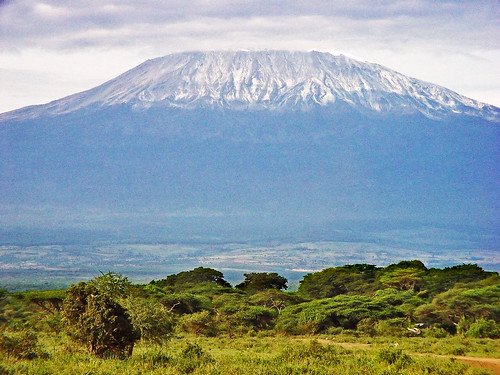
Determinants of diversity in afrotropical herbivorous insects (Lepidoptera: Geometridae): plant diversity, vegetation structure or abiotic factors?
Journal of Biogeography (J. Biogeogr.) (2009) 36: 337–349
Jan C. Axmacher1*, Gunnar Brehm2, Andreas Hemp3, Henry Tu¨nte4, Herbert V. M. Lyaruu5, Klaus Mu¨ller-Hohenstein4 and Konrad Fiedler
1UCL Department of Geography, University College London, London, UK, 2Institut fu¨r Spezielle Zoologie mit Phyletischem Museum, Friedrich-Schiller-Universita¨t Jena, Jena, 3Department of Plant Systematics, Universita¨t Bayreuth, Bayreuth, Germany, 4Department of Biogeography, Universita¨t Bayreuth, Bayreuth, Germany, 5Department of Botany, University of Dar es Salaam, Dar es Salaam, Tanzania and 6Department of Population Ecology, Vienna Ecology Centre, University of Vienna, Vienna, Austria
此研究於非洲第一高峰吉力馬札羅山在海拔1200到3150 m的範圍設置48個樣點400平方公尺的樣區,在各樣區中央針對植食性且具高多樣性的昆蟲類群 - 尺蛾科,以燈光誘集方式進行物種數量與物種更替率調查,並比較其與樣區內維管束植物種類、植被結構(包含樹冠分層、覆蓋度、葉片外形、分枝形式等資料)之關係。結果顯示尺蛾物種的多樣性與樣區內常見植物的科內物種多樣性有關(R2 = 0.49),且與植物結構指數有關(R2 = 0.22),但與整體的植物多樣性無顯著相關。尺蛾的物種更替率與植物科級多樣性之改變範圍有明顯關聯(40% explained variance),與植被外觀的改變關聯較低(25%),與整體的植物多樣性關聯更弱(5%)。然而上述大部分的比較缺乏直接關聯,透過溫度和溼度等環境因子則會同時影響植被與蛾類相,尺蛾科物種多樣性和潛在寄主植物間可能的直接連結顯得更弱。整體植物物種豐富度與尺蛾科多樣性缺乏顯著關聯,暗示熱帶的尺蛾可能對寄主植物並不太有選擇性。因此,植物多樣性與植食者的物種多樣性間的清楚關聯被認為是過於簡化的想法,維管束植物多樣性亦不能被普遍地通用為昆蟲的多樣性指標。
ABSTRACT
Aim This study was conducted to investigate the potential of predicting alpha diversity and turnover rates of a highly diverse herbivorous insect family (Geometridae) based on vascular plant species richness and vegetation structure.
Location The study was carried out on the south-western slopes of Mount Kilimanjaro within a wide range of habitats between 1200 and 3150 m elevation.
Methods The floristic and structural composition of the vegetation was recorded at 48 plots of 400 m2. Geometrid moths were sampled manually at light sources located at the plot centres. Principal components analysis, redundancy analysis and multiple linear regression were used to explore how alpha diversity and species turnover of geometrid moths are related to vegetation structure and plant species richness.
Results Alpha diversity of geometrid moths was significantly correlated with species diversity patterns in the
most common vascular plant families (R2 = 0.49) and with plant structural parameters (R2 = 0.22), but not with overall floristic diversity. Species turnover of geometrid moths was strongly linked to diversity changes in a range of plant families (40% explained variance), less strongly to changes in vegetation physiognomy (25%), and only weakly to overall floristic diversity (5%). Changes in elevation were a better predictor of both alpha diversity and species turnover of geometrid moths than any principal component extracted from the vegetation data.
Main conclusions Vegetation composition, diversity and structure all showed significant correlations with the diversity and species composition of geometrid moth assemblages. Nevertheless, in most cases relationships were indirect, via environmental parameters such as temperature and humidity, which influenced both vegetation and moth fauna. Possible direct links between geometrid diversity and potential food plants were much weaker. The lack of a significant correlation between overall plant species richness and geometrid diversity indicates that tropical geometrid moths may not be very selective in their food plant choice. Accordingly, a clear correlation between floral diversity and herbivore species richness must be regarded as overly simplistic, and the diversity of vascular plants cannot universally be used as a suitable biodiversity indicator for diverse insect taxa at higher trophic levels.
Journal of Biogeography (J. Biogeogr.) (2009) 36: 337–349
Jan C. Axmacher1*, Gunnar Brehm2, Andreas Hemp3, Henry Tu¨nte4, Herbert V. M. Lyaruu5, Klaus Mu¨ller-Hohenstein4 and Konrad Fiedler
1UCL Department of Geography, University College London, London, UK, 2Institut fu¨r Spezielle Zoologie mit Phyletischem Museum, Friedrich-Schiller-Universita¨t Jena, Jena, 3Department of Plant Systematics, Universita¨t Bayreuth, Bayreuth, Germany, 4Department of Biogeography, Universita¨t Bayreuth, Bayreuth, Germany, 5Department of Botany, University of Dar es Salaam, Dar es Salaam, Tanzania and 6Department of Population Ecology, Vienna Ecology Centre, University of Vienna, Vienna, Austria
此研究於非洲第一高峰吉力馬札羅山在海拔1200到3150 m的範圍設置48個樣點400平方公尺的樣區,在各樣區中央針對植食性且具高多樣性的昆蟲類群 - 尺蛾科,以燈光誘集方式進行物種數量與物種更替率調查,並比較其與樣區內維管束植物種類、植被結構(包含樹冠分層、覆蓋度、葉片外形、分枝形式等資料)之關係。結果顯示尺蛾物種的多樣性與樣區內常見植物的科內物種多樣性有關(R2 = 0.49),且與植物結構指數有關(R2 = 0.22),但與整體的植物多樣性無顯著相關。尺蛾的物種更替率與植物科級多樣性之改變範圍有明顯關聯(40% explained variance),與植被外觀的改變關聯較低(25%),與整體的植物多樣性關聯更弱(5%)。然而上述大部分的比較缺乏直接關聯,透過溫度和溼度等環境因子則會同時影響植被與蛾類相,尺蛾科物種多樣性和潛在寄主植物間可能的直接連結顯得更弱。整體植物物種豐富度與尺蛾科多樣性缺乏顯著關聯,暗示熱帶的尺蛾可能對寄主植物並不太有選擇性。因此,植物多樣性與植食者的物種多樣性間的清楚關聯被認為是過於簡化的想法,維管束植物多樣性亦不能被普遍地通用為昆蟲的多樣性指標。
ABSTRACT
Aim This study was conducted to investigate the potential of predicting alpha diversity and turnover rates of a highly diverse herbivorous insect family (Geometridae) based on vascular plant species richness and vegetation structure.
Location The study was carried out on the south-western slopes of Mount Kilimanjaro within a wide range of habitats between 1200 and 3150 m elevation.
Methods The floristic and structural composition of the vegetation was recorded at 48 plots of 400 m2. Geometrid moths were sampled manually at light sources located at the plot centres. Principal components analysis, redundancy analysis and multiple linear regression were used to explore how alpha diversity and species turnover of geometrid moths are related to vegetation structure and plant species richness.
Results Alpha diversity of geometrid moths was significantly correlated with species diversity patterns in the
most common vascular plant families (R2 = 0.49) and with plant structural parameters (R2 = 0.22), but not with overall floristic diversity. Species turnover of geometrid moths was strongly linked to diversity changes in a range of plant families (40% explained variance), less strongly to changes in vegetation physiognomy (25%), and only weakly to overall floristic diversity (5%). Changes in elevation were a better predictor of both alpha diversity and species turnover of geometrid moths than any principal component extracted from the vegetation data.
Main conclusions Vegetation composition, diversity and structure all showed significant correlations with the diversity and species composition of geometrid moth assemblages. Nevertheless, in most cases relationships were indirect, via environmental parameters such as temperature and humidity, which influenced both vegetation and moth fauna. Possible direct links between geometrid diversity and potential food plants were much weaker. The lack of a significant correlation between overall plant species richness and geometrid diversity indicates that tropical geometrid moths may not be very selective in their food plant choice. Accordingly, a clear correlation between floral diversity and herbivore species richness must be regarded as overly simplistic, and the diversity of vascular plants cannot universally be used as a suitable biodiversity indicator for diverse insect taxa at higher trophic levels.
2009年2月2日 星期一
大象對蝴蝶:大型草食動物在兩個熱帶世界的演化歷史所扮演的生態角色
Elephants versus butterflies: the ecological role of large herbivores in the evolutionary history of two tropical worlds Journal of Biogeography 30(9):1357–1380
Cris Cristoffer1* and Carlos A. Peres2 1CES/CEVN, Luke Air Force Base, AZ, USA, 2Centre for Ecology, Evolution & Conservation, University of East Anglia, Norwich, UK
本文分析已發表的資訊與個人通訊,試圖探討新熱帶與舊熱帶區兩者的草食性動物相存在明顯差異的原因。與新熱帶區相比,舊熱帶區擁有較多生物量的大型草食性動物,原因與具有較低多樣性的小型草食性動物、不同的原住民狩獵方式、較大的樹棲性脊椎動物、較大的果實、花與果的時空分布情形或其他因素有關。本文結果並不支持新熱帶區雨林在前全新世曾經存在過種類豐富的大型草食動物之說法。作者也不認為兩個熱帶區的動物相差異導因於在新世界區人類活動造成的動物滅絕。
Abstract
Aim
Large herbivores have important effects upon Paleotropical ecosystems, but attain much lower biomass densities in the Neotropics. We assess how this difference in herbivore activity has generated different ecological and evolutionary trajectories in the New and Old World tropics. We also propose an explanation for how the greater biomass density in the Old World came about.
Location
Data were compiled primarily from moist tropical forests, although more of the relevant information to address most of our hypotheses was available from the mainland areas of Africa, Asia, and South America than elsewhere.
Methods
We gleaned data from published information and personal communication. We compared body masses and a variety of other types of information for the New- and Old-World tropics. We proposed that interhemispheric differences exist in a variety of processes, including herbivory, frugivory, and flower visitation. We erected hypotheses and evaluated them qualitatively, and, when information was available, tested them using simple ratios of species in various taxonomic and trophic categories. To make the comparisons more meaningful, we specified appropriate data selection criteria.
Results
A general pattern of differences emerges from this review. Compared with Neotropical forests, the much greater biomass densities of large herbivores in Paleotropical forests are associated with a lesser diversity of small herbivores, different hunting methods used by indigenous humans, larger arboreal vertebrates, larger fruits, different patterns of fruit and flower dispersion in space and time, a lesser abundance of most types of reproductive plant parts, and other features. The existence of a species-rich fauna of large herbivores in the pre-Holocene Neotropical rain forest was not supported.
Main conclusions
The potential for large herbivores to cause functional differences between the New and Old World tropical forests has been virtually unexplored, despite the well-known importance of large herbivores in the Old World tropics. The evaluations of our hypotheses suggest that the abundance of large herbivores in the Old World tropics has launched it onto a different evolutionary trajectory than that of the NewWorld tropics. The relevant evidence, although scanty, suggests that the interhemispheric ecological differences are not an artefact of recent megafaunal extinctions in the New World. Recent human activities have, however, reduced population sizes of large wild herbivores in the Old World, and increased population sizes of livestock. This has likely created a rather homogeneous, anthropogenic selection pressure that tends to erase the evolutionary differences between the two tropical worlds.
本文分析已發表的資訊與個人通訊,試圖探討新熱帶與舊熱帶區兩者的草食性動物相存在明顯差異的原因。與新熱帶區相比,舊熱帶區擁有較多生物量的大型草食性動物,原因與具有較低多樣性的小型草食性動物、不同的原住民狩獵方式、較大的樹棲性脊椎動物、較大的果實、花與果的時空分布情形或其他因素有關。本文結果並不支持新熱帶區雨林在前全新世曾經存在過種類豐富的大型草食動物之說法。作者也不認為兩個熱帶區的動物相差異導因於在新世界區人類活動造成的動物滅絕。
Abstract
Aim
Large herbivores have important effects upon Paleotropical ecosystems, but attain much lower biomass densities in the Neotropics. We assess how this difference in herbivore activity has generated different ecological and evolutionary trajectories in the New and Old World tropics. We also propose an explanation for how the greater biomass density in the Old World came about.
Location
Data were compiled primarily from moist tropical forests, although more of the relevant information to address most of our hypotheses was available from the mainland areas of Africa, Asia, and South America than elsewhere.
Methods
We gleaned data from published information and personal communication. We compared body masses and a variety of other types of information for the New- and Old-World tropics. We proposed that interhemispheric differences exist in a variety of processes, including herbivory, frugivory, and flower visitation. We erected hypotheses and evaluated them qualitatively, and, when information was available, tested them using simple ratios of species in various taxonomic and trophic categories. To make the comparisons more meaningful, we specified appropriate data selection criteria.
Results
A general pattern of differences emerges from this review. Compared with Neotropical forests, the much greater biomass densities of large herbivores in Paleotropical forests are associated with a lesser diversity of small herbivores, different hunting methods used by indigenous humans, larger arboreal vertebrates, larger fruits, different patterns of fruit and flower dispersion in space and time, a lesser abundance of most types of reproductive plant parts, and other features. The existence of a species-rich fauna of large herbivores in the pre-Holocene Neotropical rain forest was not supported.
Main conclusions
The potential for large herbivores to cause functional differences between the New and Old World tropical forests has been virtually unexplored, despite the well-known importance of large herbivores in the Old World tropics. The evaluations of our hypotheses suggest that the abundance of large herbivores in the Old World tropics has launched it onto a different evolutionary trajectory than that of the NewWorld tropics. The relevant evidence, although scanty, suggests that the interhemispheric ecological differences are not an artefact of recent megafaunal extinctions in the New World. Recent human activities have, however, reduced population sizes of large wild herbivores in the Old World, and increased population sizes of livestock. This has likely created a rather homogeneous, anthropogenic selection pressure that tends to erase the evolutionary differences between the two tropical worlds.
訂閱:
文章 (Atom)