顯示具有 Hostplant utilization 標籤的文章。 顯示所有文章

2011年11月3日 星期四

使用七個基因與109個物種的分析結果顯示旋蛾總科的幼蟲食性可能造就其高度的多樣性

文獻來源: Kaila L, Mutanen M, Nyman T. 2011. Phylogeny of the mega-diverse Gelechioidea (Lepidoptera): Adaptations and determinants of success. Molecular Phylogenetics and Evolution 61(2011): 801-809.

Abstract
The Gelechioidea, with 18,000 described and many more unnamed species ranks among the most diverse lepidopteran superfamilies. Nevertheless, their taxonomy has remained largely unresolved, and phylogenetic affinities among gelechioid families and lower taxa have been insufficiently understood. We constructed, for the first time, a comprehensive molecular phylogeny for the Gelechioidea. We sampled seven genes, in total 5466 base pairs, of 109 gelechioid taxa representing 32 of 37 recognized subfamilies, and two outgroup taxa. We used maximum likelihood methods and Bayesian inference to construct phylogenetic trees. We found that the families Autostichidae, Lecithoceridae, Xyloryctidae, and Oecophoridae s. str., in this order, are the most basally arising clades. Elachistidae s. l. was found to be paraphyletic, with families such as Gelechiidae and Cosmopterigidae nested within it, and Parametriotinae associated with several families previously considered unrelated to them. Using the phylogenetic trees, we examined patterns of life history evolution and determinants of the success of different lineages. Gelechioids express unusually wide variability in life-history strategies, including herbivorous, saprophagous, fungivorous, and carnivorous lineages. Most species are highly specialized in diet and other life history traits. The results suggest that either saprophagy was the ancestral feeding strategy from which herbivory evolved independently on multiple occasions, or that the ancestor was herbivorous with repeated origins of saprophagy. External feeding is an ancestral trait from which internal feeding evolved independently several times. In terms of species number, saprophages are dominant in Australia, while elsewhere several phytophagous lineages have extensively specialized and diversified. Internal feeding has remained a somewhat less generally adopted feeding mode, although in a few lineages significant radiations of leaf mining species have occurred. We conclude that diverse feeding modes, specialization among saprophages, repeated shifts to phytophagy, and a generally high specialization rate on single plant species (monophagy) are the major factors behind the success of the Gelechioidea.

圖片拍攝: 吳士緯

2011年8月14日 星期日

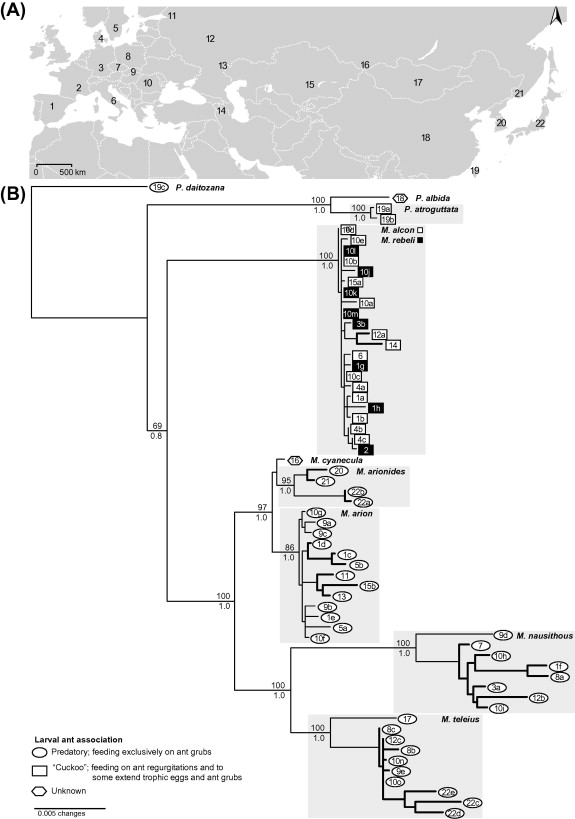
使用四個核基因與兩個粒線體DNA序列重建藍灰蝶節親緣關係時發現大藍灰蝶(Maculinea)的單系性的確因雀斑灰蝶(Phengaris)的插入而不復存在, 而稀有的碇灰蝶(Caeruelea)則為其姐妹群

文獻來源: Ugelvig LV, Vila R, Pierce NE, Nash DR. 2011. A phylogenetic revision of the Glaucopsyche section (Lepidoptera: Lycaenidae), with special focus on the Phengaris–Maculinea clade. Molecular Phylogenetics and Evolution 61(1): 237-243.

Abstract
Despite much research on the socially parasitic large blue butterflies (genus Maculinea) in the past 40 years, their relationship to their closest relatives, Phengaris, is controversial and the relationships among the remaining genera in the Glaucopsyche section are largely unresolved. The evolutionary history of this butterfly section is particularly important to understand the evolution of life history diversity connected to food-plant and host-ant associations in the larval stage. In the present study, we use a combination of four nuclear and two mitochondrial genes to reconstruct the phylogeny of the Glaucopsyche section, and in particular, to study the relationships among and within the Phengaris–Maculinea species.
We find a clear pattern between the clades recovered in the Glaucopsyche section phylogeny and their food-plant associations, with only the Phengaris–Maculinea clade utilising more than one plant family. Maculinea is, for the first time, recovered with strong support as a monophyletic group nested within Phengaris, with the closest relative being the rare genus Caerulea. The genus Glaucopsyche is polyphyletic, including the genera Sinia and Iolana. Interestingly, we find evidence for additional potential cryptic species within the highly endangered Maculinea, which has long been suspected from morphological, ecological and molecular studies.

2010年8月10日 星期二

掠食性黃蜂學習克服弄蝶幼蟲之防禦性巢室

文獻來源:Weiss MR, Wilson EE & Castellanos I (2004) Predatory wasps learn to overcome the shelter defences of their larval prey. Animal Behaviour 68: 45-54. [Abstract]

簡介:銀斑弄蝶 (Epargyreus clarus) 的幼蟲會利用豆科食草造巢。自然界中其掠食者長腳蜂 (Polistes spp. ) 會降落在巢室上,快速地取出並殺死幼蟲,但由實驗室孵化出的長腳蜂卻極少數地取出並殺死巢室中的幼蟲。為了了解學習是否有助於長腳蜂成功掠食巢中幼蟲, Weiss 等人測試兩種黃蜂 (Polistes fuscatus 和 Polistes dominulus) 在遇到(1)寄主植物上開放巢室的幼蟲以及(2)非寄主植物無巢室的幼蟲之前後反應。實驗結果顯示,掠食者在成功地殺死開放巢室中可見的幼蟲後,大部分的掠食者都可以成功捕食巢室中的幼蟲;反之掠食者在捕食無巢室之幼蟲後,通常之後無法打開巢室。因此,Weiss等人認為黃蜂必須經過學習,將幼蟲的味道和巢室相關的信號 (例如絲及葉子的破損) 作聯結,在野外幼蟲在巢室中或巢室周圍取食或作巢即會暴露於掠食者,幼蟲的密度也會影響到掠食者學習的機會。此篇文章也證實無脊椎掠食者可以透過學習來客服獵物之防禦行為,並成功取食先前無法取得之獵物。

2010年5月29日 星期六

緯度影響群居性幼蟲之生活史特性

文獻來源: Pimentel C, Ferreira C and Nilsson J-Å. 2010. Latitudinal gradients and the shaping of life-history traits in a gregarious caterpillar. Biological Journal of the Linnean Society 100: 224-236.

簡介
此研究以松舟蛾 (pine processionary moth,
Thaumetopoea pityocampa) 為例,探討地理因子的影響會如何塑造群居性物種之生活史特性。松舟蛾廣泛分布於地中海地區,其幼蟲為一典型之群聚性物種,一個群落由一雌性成蟲所產的一批卵組成,為地中海地區多種松樹的重要經濟害蟲。此研究回顧了整個地中海地區關於松舟蛾之文獻,特別針對松舟蛾在不同緯度、海拔、溫度及寄主植物的影響下,其生育力(卵之個數)、卵之大小、卵寄生蜂導致之死亡率、成蟲飛行時間、以及幼蟲成長時間之變化進行探討。結果顯示隨著緯度增加,松舟蛾的生育力有增加趨勢,但卵的大小並沒有隨之增加,松舟蛾於高緯度地區擁有較大的群落被認為與造巢策略及熱能調節有關,因此會隨著緯度權衡卵之大小與數目。除此之外,松舟蛾在不同寄主植物下,也會因針葉的堅硬度及氮的含量而影響卵之大小與數量。

Abstract
The present study aimed to investigate how the impact of several factors linked to geography would shape history traits in a gregarious species, using the pine processionary moth (PPM) Thaumetopoea pityocampa as model system. PPM has a wide geographical distribution over the Mediterranean Basin, and it is a strictly gregarious species throughout larval development, where the total reproductive output of each female forms a colony. We reviewed both published and unpublished data on PPM from all over its distribution in the Mediterranean Basin and extracted data on fecundity, egg size, egg parasitoid mortality, flight period, and development time. These life-history traits were then related to location, expressed as latitude and altitude, local average temperatures, and host tree species. We found that PPM fecundity increaseed with latitude, concomitant with an increase in the length of development and an earlier onset of adult flight. These results are the opposite of that found in other Lepidoptera species with a wide geographical distribution, as well as in insects in general. We propose that a large colony size in PPM is important at higher latitudes because this confers an advantage for thermoregulation and tent building in areas where larvae have to face harsher conditions during the winter, thus shifting the optimal trade-off between the number and size of eggs with latitude. However, host tree species also affected the relationship between egg number and size and the optimal outcome of these traits is likely a compromise between different selection pressures.

2009年1月20日 星期二

可塑性會驅使演化嗎?第三紀時期的蛺蝶寄主植物轉移與多樣化

(本圖片由wanderingnome上載至flickr網站)
Does plasticity drive speciation? Host plant shifts and diversification in nymphaline butterflies (Lepidoptera: Nymphalidae) during the tertiary
Biological Journal of the Linnean Society 94: 115-130.pdf

Nylin, S. & Wahlberg, N. 2008

Abstract.

How and why the great diversity of phytophagous insects has evolved is not clear but, if the explanation is the diversity of plants as a resource, colonizations of novel plant taxa can be expected to be associated with higher net speciation rates. In the present study, we make use of recent advances in plant and butterfly systematics to trace the evolution of host-plant utilization in the butterfly subfamily Nymphalinae (tribes Nymphalini, Melitaeini, and the probably paraphyletic ‘Kallimini’). A clear historical pattern emerges, with an ancestral host-plant theme of ‘urticalean rosids’ and two major colonizations of novel distantly-related plant clades. The asterid order Lamiales was colonized by an ancestor of ‘Kallimini’ + Melitaeini and the family Asteraceae in Asterales was later colonized by Melitaeini butterflies. These colonization events appear to have been followed by increases in the rate of net butterfly diversification. Two not mutually exclusive scenarios to explain such patterns have been suggested: (1) adaptive radiation due to release from competition following host-plant shifts or (2) higher rates of net speciation during a relatively long-lasting potentially polyphagous (plastic) state. In support of the ‘plasticity scenario’, phylogenetic traces of a long-lasting stage with some potential to feed on more than one host-plant clade can still be seen, despite the ancient age of the colonizations. When angiosperm communities changed after the K/T boundary due to extinctions and subsequent diversification, herbivore taxa that could occupy several alternative niches may have had the greatest opportunity to diversify in turn.

史前氣候變化增加一群蝴蝶的多樣性


Prehistorical climate change increased diversification of a group of butterflies.

Biology Letters
4: 274-278.pdf. Supplementary material. See commentary in Telegraph


Peña, C., & N. Wahlberg 2008

Abstract.
Satyrinae butterflies (Lepidoptera: Nymphalidae) and grasses (Poaceae) are very diverse and distributed worldwide. Most Satyrinae use grasses as host plants, but the temporal scale of this tight association is not known. Here, we present a phylogenetic study of Satyrinae butterflies and related groups, based on 5.1 kilobases from six gene regions and 238 morphological characters for all major lineages in the ‘satyrine clade’. Estimates of divergence times calibrated using a fossil from the Late Oligocene indicate that the species-rich tribe Satyrini diversified to its current 2200 species simultaneously with the expansion and radiation of grasses during the dramatic cooling and drying up of the Earth in the Oligocene. We suggest that the adaptive radiation of grass feeders in Satyrini has been facilitated by the ubiquitousness of grasses since 25 Myr ago, which was triggered by a change in global climate.

珍蝶族之親緣關係與寄主植物利用的演化


Phylogenetic relationships of butterflies of the tribe Acraeini (Lepidoptera, Nymphalidae, Heliconiinae) and the evolution of host plant use. Molecular Phylogenetics and Evolution 46:515-531 pdf.

Silva Brandão, K. L., N. Wahlberg, R. B. Francini, A. M. L. Azeredo-Espin, K. S. Brown Jr., M. Paluch, D. C. Lees, and A. V. L. Freitas.


Abstract.

The tribe Acraeini (Nymphalidae, Heliconiinae) is believed to comprise between one and seven genera, with the greatest diversity in Africa. The genera Abananote, Altinote, and Actinote (s. str.) are distributed in the Neotropics, while the genera Acraea, Bematistes, Miyana, and Pardopsis have a Palaeotropical distribution. The monotypic Pardopsis use herbaceous plants of the family Violaceae, Acraea and Bematistes feed selectively on plants with cyanoglycosides belonging to many plant families, but preferentially to Passifloraceae, and all Neotropical species with a known life cycle feed on Asteraceae only. Here, a molecular phylogeny is proposed for the butterflies of the tribe Acraeini based on sequences of COI, EF-1a and wgl. Both Maximum Parsimony and Bayesian analyses showed that the tribe is monophyletic, once the genus Pardopsis is excluded, since it appears to be related to Argynnini. The existing genus Acraea is a paraphyletic group with regard to the South American genera, and the species of Acraea belonging to the group of ‘‘Old World Actinote” is the sister group of the Neotropical genera. The monophyly of South American clade is strongly supported, suggesting a single colonization event of South America. The New World Actinote (s. str.) is monophyletic, and sister to Abananote + Altinote (polyphyletic). Based on the present results it was possible to propose a scenario for the evolution in host plant use within Acraeini, mainly concerning the use of Asteraceae by the South American genera.


2009年1月8日 星期四

紅蛺蝶幼蟲從小到大造巢位置的改變

Ontogenetic changes in the shelter site of a leaf-folding caterpillar, Vanessa indica

Jun-Ya Ide*

Department of Environmental Science, Graduate School of Science and Technology, Kumamoto University, Kumamoto, Japan *Correspondence and present address: Laboratory of Insect Ecology, Graduate School of Agriculture, Kyoto University, Kitashirakawa Oiwake-cho, Sakyo, Kyoto 606-8502, Japan. E-mail: idejy@kais.kyoto-u.ac.jp

ABSTRACT


Factors responsible for ontogenetic habitat shifts were examined using larvae of the Indian red admiral butterfly, Vanessa indica (Herbst) (Lepidoptera: Nymphalidae). The larvae of V. indica fold leaves of China ramie, Boehmeria nipononivea Koidz. (Urticaceae), to form shelters that also serve as food. When constructing shelters, old larvae (usually third instar or older) frequently cut trenches at the bases of the leaves, whereas younger larvae do not. This trenching behaviour reduces the force required to fold large ramie leaves. Young larvae used small apical leaves as shelter sites. Once larvae were capable of cutting trenches, they moved proximally on the host plant and used middle leaves that either had completed or were about to complete expansion. Results of bioassays revealed that, for young larvae, apical and middle leaves did not differ in food quality. In contrast, for older larvae, the quality of middle leaves was higher than that of apical leaves. These observations suggest that young larvae decrease the risk of predation during shelter construction by using apical leaves that are relatively easy to fold, and that old larvae employ trenching to decrease the duration of leaf folding and improve growth rate by using middle leaves that are of high quality. Thus, the facilitation of leaf-folding by trenching is considered to reduce the necessity of using apical leaves, and the acquisition of the trenching ability triggers an ontogenetic shift in the selection of larval shelter sites.

圖片連結: www.srilankabutterflies.com

2008年10月6日 星期一

[Article]Molecular phylogenetics of heliothine moths

Molecular phylogenetics of heliothine moths (Lepidoptera: Noctuidae: Heliothinae), with comments on the evolution of host range and pest status
Full Text: HTML, PDF (Size: 675K)
Authors: CHO, SOOWON; MITCHELL, ANDREW1; MITTER, CHARLES2; REGIER, JEROME3; MATTHEWS, MARCUS; ROBERTSON, RON

Source: Systematic Entomology, Volume 33, Number 4, October 2008 , pp. 581-594(14)

Abstract: The Heliothinae are a cosmopolitan subfamily of about 365 species that include some of the world's most injurious crop pests. This study re-assesses evolutionary relationships within heliothines, providing an improved phylogeny and classification to support ongoing intensive research on heliothine genomics, systematics, and biology. Our phylogeny estimate is based on two nuclear gene regions, namely elongation factor-1α (EF-1α; 1240 bp) and dopa decarboxylase (DDC; 687 bp), and on the barcoding region of mitochondrial cytochrome oxidase I (COI; 708 bp), providing a total of 2635 bp. These were sequenced for 71 heliothines, representing all major genera and nearly all recognized subgenera and species groups, and for 16 outgroups representing all major lineages of trifine Noctuidae. Analysis of the combined data by maximum likelihood, unweighted parsimony and Bayesian methods gave nearly identical topologies, and the individual gene trees showed only one case of potentially strong conflict. Relationships among genera and subgenera are resolved with strong bootstrap support. The earliest-diverging lineages (c. 200 species in total) consist almost entirely of host specialists, reflecting the inferred ancestral heliothine host range under parsimony. The remaining species form a clade - the Heliothis group - that includes most of the polyphages (30% of heliothines) and all of the major pests. Many other species in the Heliothis group, however, are host specialists. Our results extend previous efforts to subdivide this large clade, and show the most notorious pest groups, the corn earworm complex (Helicoverpa) and the tobacco budworm (Heliothis virescens) group, to be closely related, joining with a small oligophagous genus in what we term the major-pest lineage. Thus, genomic/experimental results from one model pest may extrapolate well to other pest species. The frequency of evolutionary expansion and contraction in host range appears to increase dramatically at the base of the Heliothis group, in contrast to the case for earlier-diverging lineages. We ascribe this difference provisionally to differential evolutionary constraints arising from contrasting life-history syndromes. Host-specific behaviour and crypsis, coupled with low fecundity and vagility, may discourage host-range expansion in earlier-diverging lineages. By contrast, in the Heliothis group, the absence of host-specific traits, coupled with high vagility and fecundity, may more readily permit expansion or contraction of the host range in response to varying ecological pressures such as host species abundance or differential competition and predation.