顯示具有 Neotropical region 標籤的文章。 顯示所有文章

2011年12月4日 星期日

由形態特徵重建新熱帶美洲蛺蝶Hamadryas屬之親緣關係並著重發聲結構的失去與其他替代性別辨識機制產生的討論

文獻來源:Garzo-Orduna, I. J. 2011. Phylogenetic evidence for loss of sound production and a shift in sexual recognition signals in Hamadryas butterflies (Nymphalidae: Biblidinae). Systematic Entomology. DOI: 10.1111/j.1365-3113.2011.00599.x

簡介

分布於新熱帶美洲的Hamadryas屬為蛺蝶科Biblidinae亞科類群,共計有20個物種,當中約有近半數具有前翅發聲結構、少數具有雌雄翅紋二型性與雄蟲具發香鱗片的種類。由過去的生物學顯示此屬辨識特徵尚有翅背面如花部狀紋路、吸食腐敗果實、停棲時頭下尾上以及飛行路徑飄忽不定。

過去30年間雖然有此屬的屬內歸群處理,然而尚未有以支序學所建立的親緣關係研究,本文章即首次以形態特徵重建親緣,並討論以下議題:(1) Hamadryas是否為一單系枝系,具有哪些衍徵來支持?(2) 此屬姊妹群為何? (3) 評估過去所建立亞屬之單系性;(4) 演化上如發聲、二型性與發香鱗等特徵出現與先後的判定與討論。

結果討論顯示

(1) Hamadryas屬為單系群;

(2) 此屬姊妹群為Ectima屬;

(3) 除了H. laodamia枝系外其餘過去之屬內亞屬歸群皆非單系群;

(4) 在發聲、二型性與發香鱗等特徵的演化上,發聲結構在特徵分析中被拆解為獨立的四個前翅翅脈特徵,然而能夠發聲的行為僅產生過一次(單一起源),該枝系當中的H. laodamia與其近緣種則再次失去此發聲結構。雖然H. laodamia枝系失去發聲能力,此支系卻擁有雄蟲發香鱗與翅型/翅紋雌雄二型性的特徵。作者因此認為若發聲行為是作為物種辨識用,則失去發聲行為的枝系則以發香鱗與二型性等特徵替代辨識。目前尚不清楚此三特徵組的出現順序,待後續研究。

(5) 藉由親緣關係樹所得之雌雄二型性特徵分佈,作者也比對此結果是否符合過去三個雌雄二型性起源假說(註)之一。由於雌雄二型性枝系H. laodamia的雌蟲翅紋為祖徵,而雄蟲翅紋為衍徵,因此雖然沒有直接的證據支持,此結果仍較符合達爾文所提出的雌蟲偏好特定雄蟲特徵的假說;

(6) 由於所重建之親緣關係樹整體樹型支持度不高,後續仍有待幼蟲形態資訊以及分子證據的加入,此外對於雌雄蟲辨識所利用特徵的方式,則需要更詳盡的野外觀察與網室試驗來解釋。

註:過去三個主要之雌雄二型性起源假說

(1) 達爾文 (1971) - 性擇假說,由雌性偏好與特定雄性產生後代的選汰方式達成;

(2) 華萊士 (1889) - 天擇假說:雌性儘可能產生隱蔽自身的形狀、斑紋等(相對於祖先型者)來增加適存值;

(3) Silberglied (1984)- 雄性間互動假說:雄性藉由視覺來辨識其他雄性個體的物種異同,並用以對同種雌性進行展示。

Abstract

The neotropical butterfly genus Hamadryas Hubner comprises 20 species that exhibit an intriguing variation in their natural history traits. Although revised in 1983, no phylogenetic hypothesis was presented: the first phylogenetic hypothesis is estimated here based on 93 characters and including species from the three other genera in the tribe Ageroniini. The phylogeny is used to test the monophyly of the genus, establish the sister group of Hamadryas and identify its apomorphies. The tree allows the inference of patterns of character change in sound production and sexual dimorphism. Implied weights show that Hamadryas is monophyletic and corroborate Ectima Doubleday as a sister genus. Previously suggested subgenera for Hamadryas were non-monophyletic, with the exception of the laodamia clade, supported by the presence of a complete sterigma. Sound production is inferred to be a derived condition in Hamadryas that has been lost in the laodamia clade. This, plus the presence of androconial organs and sexual dimorphism in the laodamia clade, suggests a shift in sexual recognition signalling. Furthermore, the phylogeny indicates that the colour pattern of males in the laodamia clade is novel, supporting a Darwinian origin of sexual dimorphism.

2011年6月6日 星期一

以標準化流程進行不同地理區的熱帶雨林蝶類多樣性比較

文獻來源: Y Basset, R Eastwood, L Sam, DJ Lohman, V Novotny, T Treuer, SE Miller, GD Weiblen, NE Pierce, S Bunyavejchewin, W Sakchoowong, P Kongnoo and MA Osorio-Arenas. 2011. Comparison of rainforest butterfly assemblages across three biogeographical regions using standardized protocols. The Journal of Research on the Lepidoptera 44: 17-2.

摘要

與大多數其他生物一樣,昆蟲的多樣性在熱帶區域較溫帶區域為高,然而熱帶各區域之間的標準化比較研究相當稀少。要解開影響群聚多樣性的生態,演化與生物地理因子需要標準化的作業流程和長期研究。作者在低地雨林鬱閉樹冠的底層以Pollard walk穿越線計數法比較巴拿馬的巴羅科羅拉多島(BCI),泰國的拷秋(KHC)與新幾內亞的瓦那(WAN)共三個地點的蝴蝶豐富度和多樣性。作者在上述三地分別以231、231120次穿越線調查,觀察到1792、 2797 3331隻蝴蝶個體,各有128、 131134個物種。分別對穿越線長度和調查時間長度進行數據校正後,結果顯示蝴蝶數量與物種豐富度分別在WANKHC最高。雖然在WAN的蝴蝶豐富度看來似乎並非由於人工方法所造成,此觀察的生物學上意義仍然是模糊的。WAN地區的植物多樣性與KHC相當,但是所擁有的蝴蝶霧種多樣性卻較KHC低。此現象強調了在植物多樣性之外的因素,例如生物地理歷史,對於解釋造成蝶類多樣性的成因的重要性。KHC特別多樣的蝴蝶相可能是由於其地理位置位在印度中國區和巽它大陸區的交會點。相反的,WAN則穩固位在澳洲地理區,且其較低的物種多樣性可能導因自島嶼生物地理過程。這三個地點的常見物種皆有幾個特色:食果和食蜜者平均出現,超過一半的常見種幼蟲時期取食附生植物或藤蔓類,且他們的翅長近似。由這些觀察推測, Pollard walk穿越線計數法在不同的熱帶雨林樣區指出了常見種的相似集合,並且是一個熱帶雨林蝴蝶組成長期監測的有用工具。

Abstract. Insects, like most other organisms, are more diverse in tropical than in temperate regions, but standardized comparisons of diversity among tropical regions are rare. Disentangling the effects of ecological, evolutionary, and biogeographic factors on community diversity requires standardized protocols and long-term studies. We compared the abundance and diversity of butterflies using standardised ‘Pollard walk’ transect counts in the understory of closed-canopy lowland rainforests in Panama (Barro Colorado Island, BCI), Thailand (Khao Chong, KHC) and Papua New Guinea (Wanang, WAN). We observed 1792, 1797 and 3331 butterflies representing 128, 131 and 134 species during 230, 231 and 120 transects at BCI, KHC and WAN, respectively. When corrected for length and duration of transects, butterfly abundance and species richness were highest at WAN and KHC, respectively. Although high butterfly abundance at WAN did not appear to result from methodological artefacts, the biological meaning of this observation remains obscure. The WAN site appeared as floristically diverse as KHC, but supported lower butterfly diversity. This emphasizes that factors other than plant diversity, such as biogeographic history, may be crucial for explaining butterfly diversity. The KHC butterfly fauna may be unusually species rich because the site is at a biogeographic crossroads between the Indochinese and Sundaland regions. In contrast, WAN is firmly within the Australian biogeographic region and relatively low species numbers may result from island biogeographic processes. The common species at each of the three sites shared several traits: fruit and nectar feeders were equally represented, more than half of common species fed on either epiphytes or lianas as larvae, and their range in wing sizes was similar. These observations suggest that Pollard walks in different tropical rainforests target similar assemblages of common species, and, hence, represent a useful tool for long-term monitoring of rainforest butterfly assemblages.

Keywords: Barro Colorado Island, Center for Tropical Forest Science, Lepidoptera, tropical rainforest, Panama, Papua New Guinea, Pollard walks, Smithsonian Institution Global Earth Observatories, Thailand.

Received: 22 December 2010
Accepted:
24 January 2011
Published online at www.lepidopteraresearchfoundation.org on 4 May 2011

2009年10月4日 星期日

星燈蛾屬分類學回顧與加拉巴哥產類群研究進展


星燈蛾屬的分佈與分類簡述
星燈蛾屬(Utehteisa)為夜蛾科燈蛾亞科燈蛾族(註一)中日行性活動的類群,屬內現分為四個亞屬,其一是過去挾義星燈蛾(Utetheisa sensu stricto)所限的星燈蛾亞屬,全世界大約20~30種,當中含廣泛分布於舊世界的U. pulchellaU. pulchelloidesU. lotrix(後兩者亦分佈於台灣),以及新世界的U. ornatrixU. bella,此亞屬類群之胸翅部具有紅黑白色塊斑紋,並取食紫草科的白水木屬(Tournefortia)植物,長久被認為利用此寄主的次級代謝物-氰化物(PAs)進行對天敵的化學防禦機制,並以警戒斑紋使天敵增強對星燈蛾有毒或不可食性(unpalatable)的印象。其餘三亞屬分別於Holloway (1988)(PitasilaAtasca)以及de Vos (2007)(Raanya)置於星燈蛾屬下(詳見de Vos文章與本Blog對其文章的介紹)。此三屬在外觀上近似於燈蛾族成員蝶燈蛾屬(Nyctemera), 然根據明尼蘇達大學Susan Weller研究群對燈蛾科親緣關係重建的結果,NyctemeraPitasila並非近緣群,而Pitasila顯然應被視為星燈蛾屬Utetheisa亞屬。三亞屬已知皆分佈於印澳區(Indo-Australian region),所含物種數為25、13與1種,台灣有U. (Pitasila) fractifascia (模式標本)與U. (Pitasila) inconstans (原名模式標本成蟲幼蟲生態影像),前者為台灣特有種,後者為分布於台灣與日本,並於2009年由傅建明與徐渙之先生確認其於綠島與蘭嶼的分佈。

加拉巴哥群島產星燈蛾屬研究史回顧
加拉巴哥距其南美洲屬國厄瓜多海岸線以西約971公里,為由大小不一的19座島嶼所組成的群島,其盛名與演化論提出者達爾文的旅航與該地相關研究有密切關係,其獨特的動植物相亦吸引生物學家屢屢造訪。事實上達爾文的造訪也與該群島星燈蛾屬的研究史有關,Butler (1877)指出達爾文曾經於群島上採集到廣泛分布於新世界的U. ornatrix,然而此證據標本至今無法由典藏於大英博物館的達爾文採集品中尋獲,而成為此島群研究史中其中的一個謎。Wallengren於1860年發表了第一種加拉巴哥特有的星燈蛾U. galapagensis(註二),後續有Hayes (1975)所發表的U. perryiU. devriesi兩新種,以及後續大約四篇對這些物種的群島內新地理分佈紀錄的文章。

加拉巴哥產星燈蛾之所以會被研究者關注,一方面是此屬為該群島鱗翅目特有率第三高的類群,並且是唯一分布於此地的燈蛾亞科;一方面是此群島所包含的星燈蛾除了新世界廣佈種U. ornatrix具有警戒色以外,其餘物種皆為灰褐色調,這個觀察使得加拉巴哥特有星燈蛾的化學防禦機制、日夜活動行為以及非警戒型顏色斑紋被拿來與典型星燈蛾做比較,並進一步探討此類群是否受不同的選汰壓力而演化。於此,Roque-Albelo等人於2002年對此觀察提出了四個假說: (1) 此類群具有化學防禦之不可被食性(unpalatable),然而大多為夜行性活動因此使得日間視覺上警戒天敵的鮮明顏色不再被需要;(2) 具有化學防禦且為日行性,然而利用隱蔽的灰褐色作為第二線的防禦機制; (3) 沒有化學防禦因此具可被食性,也因此不需要具有警戒色來宣示其不好吃; (4) 既沒有化學防禦又是夜行性,因此就不需要具有警戒色。而Roque-Albelo等人雖然確認U. galapagensis幼蟲取食白水木屬植物並且能夠分泌氰化物,然而並沒有測試此物種的可被食性。Garrett等人於2008年的研究中選取了加拉巴哥特有的蜘蛛與火山岩蜥蜴作為U. galapagensis是否具有可被食性的實驗,並且使用同域分佈的螟蛾科物種作為控制組中的獵物。其結果顯示相對於控制組螟蛾被兩天敵完全取食,U. galapagensis實驗組中的蜘蛛會使用口氣接觸星燈蛾,最後將其棄於巢外,而蜥蜴並未取食所有星燈蛾,並顯示出勉強吞食的行為,以及取食後清理行為,少數情況蜥蜴嘗試取食後會再將星燈蛾吐出。Garrett等人對Roque-Albelo等人的假說提出討論,他們認為取食研究支持了前兩個假說,也就是以化學物質來抵禦夜行性蜘蛛,並以隱避色降低被蜥蜴的攻擊。此外另外兩特有種U. perryiU. devriesi也正用來進行類似的取食實驗 (Hartmann et al., unpublished)。

這些觀察與假說測試,使Roque-Albelo等人 (2009)又衍生出了幾個對加拉巴哥特有、具隱蔽色星燈蛾類群演化上的興趣: (1) 這些星燈蛾是何時失去警戒色的? 又是什麼原因造成的 (2) 這些具隱避色類群是否由具警戒色的祖先拓殖至加拉巴哥,抑或是由夜行性具隱蔽色的祖先而來?

加拉巴哥群島產星燈蛾屬兩新物種描述
Roque-Albelo與Landry (2009)近期發表了兩新種U. connerorumU. henrii,前種廣佈於群島,後者限於San Cristobal Island,並紀錄兩者皆取食厄瓜多特有白水木類群T. pubescens。此外並重新確認U. galapagensis僅分布於San Cristobal Island,並提供加拉巴哥此屬六物種的外部型態檢索表。作者在文中提及DeCosta對U. galapagensis與新種U. connerorum進行粒線體DNA之COI序列進行分析,在668鹼基對中遺傳距離介於1.06~2.26%,並建議兩者具有近緣關係。未來是否會加入其他特有種與警戒色類群一起分析探討加拉巴哥星燈蛾的起源? 著實令人期待。

註一: Lafontaine & Fibiger (2006)依據現有的形態資料,參考Mitchell et al. (2006)年的分子親緣關係,並考量到各分類群的單系性,提出夜蛾總科新的分類架構,當中將過去的燈蛾科與毒蛾科降為廣義夜蛾科中亞科的階層。夜蛾總科的分類研究現況將在未來再做介紹。

註二: Roque-Albelo與Landry (2009)提及U. galapagensis在Wallengren (1860)的原始發表中命名為Euchelia galapagenis,卻在Wallengren (1861)中將此種種小名載為galapagensis,然而並未指出更名的原因,因此1861年的galapagensis應為不正確的後續拼法(incorrect subsequent spelling)。然而galapagensis被所有後續研究者所盛行使用,故參考ICZN 33.3.1法規將此種小名考量為正當訂正 (justified emendation)並成為此物種的有效名。

相關網路資料
世界產星燈蛾名錄

參考文獻
Fu CM and Hsu HC. 2009. Moths of Green Island. Taichung: Taichung Nature Research Society, 78pp.
Garrett SE, Conner WE and Roque-Albelo L. 2008. Alkaloidal protection of Utetheisa galapagensis against an invertebrate and a vertebrate predator in the Galapagos Islands. Galapagos
Research 65: 2–6.
Hayes A. 1975. The larger moths of the Galapagos Islands (Geometroidea, Sphingoidea and Noctuoidea). Proceedings of the California Academy of Sciences 40(4): 145–208.
Holloway JD. 1988. The moths of Borneo, part 6: Actiidae: Syntominae, Euchromiinae, Arctiinae, Aganainae (to Noctuidae). Southdene Sdn. Bhd, Malaysia.
Roque-Albelo L, Garrett SE, Conner WE. 2009. Darwin’s moth: Utetheisa in the Galapagos Islands. In: Conner WE (Ed.) Tiger Moths and Woolly Bears: Behavior, Ecology, and Evolution of the Arctiidae. Oxford, Oxford University Press, 207–222. [Google Library線上部份閱覽本Blog對此書的介紹]
Roque-Albelo L, Landry B. 2002. The Sphingidae (Lepidoptera) of the Galapagos Islands: their identifi cation, distribution, and host plants, with new records. Bulletin de la Societe Entomologique Suisse 74: 217–226.
Roque-Albelo L, Schroeder FC, Conner WE, Bezzerides A, Hoebeke ER, Meinwald J and Eisner T.
2002. Chemical defense and aposematism: the case of Utetheisa galapagensis. Chemoecology 12: 153–157.
Roque-Albelo L and Landry B. 2009. Two new species of Utetheisa Hubner (Lepidoptera, Noctuidae, Arctiinae) from the Galapagos Islands, Ecuador. ZooKeys 21: 55–72
Vos R de. 2007. The Utetheisa species of the subgenera Pitasila, Atasca and Raanya Subg. N. (Insecta, Lepidoptera: Arctiidae). Aldrovandia 3: 31-120.
Wallengren HDJ. 1860. Lepidopterologische Mittheilungen. II. Wiener Entomologische Monatschrift 4(6): 161–176.
Wallengren HDJ. 1861. Lepidoptera species novas descripsit. In: Kongliga Svenska Fregatten Eugenies Resa Omkring Jorden... Zoologi V, Insecta, pp. 351–390, 3 pls.

2009年9月2日 星期三

以成蟲形態證據重建天蠶蛾科Arsenurinae亞科親緣關係

影像連結自此
Cladistic analysis of the subfamily Arsenurinae (Lepidoptera, Saturniidae) basedon adult morphology

文獻來源:
de Camargo AJA, Mielke OHH & Casagrande MM. 2009. Cladistic analysis of the subfamily Arsenurinae (Lepidoptera, Saturniidae) based on adult morphology. Zootaxa 2218: 1-34, plates.
簡介
Arsenurinae亞科被認為是一群包含63種10屬,且僅分布於新世界的天蠶蛾類群。由過去的研究中得到此類群共同的外部形態特徵有體多呈灰褐色(除Almeidaia)、後翅(由其是雄蟲者)延伸形成尾突以及腹部第一節具有成對的毛束等,各族與屬級間的親緣關係亦有文章討論,而本文則主要是針對此亞科的單系性進行分析。在材料上作者共取得了63種中的61種Arsenurinae亞科物種作為內群,外群選用過去研究被認為與Arsenurinae亞科關係較近的Ceratocampinae與Oxyteninaeu亞科各一種
方法上使用近年來漸被形態分析研究者所採納的軟體NONA進行親緣關係重建。作者選用的特徵組中將多數雌雄蟲結構分成不同特徵來討論,所分析的40組二態與多態特徵包含了頭部觸角、胸部結構與足部距刺有無、前後翅形狀、翅脈相與翅顏色斑紋、腹部第一節毛束有無以及雄雌蟲生殖器結構。所得的結果顯示此亞科確實為一單系群,同時各族級與屬級的單系性與親緣關係也被支持與並重建。

Abstract
The family Saturniidae is distributed on all continents except polar areas, and includes about 1528 species in 162 genera, being the group with the largest diversity among Bombycoidea. Approximately 970 species are known from the New World. However, recent molecular studies indicate 1861 species in 162 genera and nine subfamilies. The family Arsenurinae consists of 63 species distributed exclusively in ten Neotropical genera, with phylogenetic relationships poorly understood. The goal of this study was to test the monophyly of the subfamily, tribes and genera using cladistic analysis of adult morphological characters. The subfamily, tribes and genera were all recovered as monophyletic groups with the following relationships among genera: (Almeidaia ((Loxolomia, Copiopteryx) ((Rhescyntis) ((Grammopelta, Arsenura) ((Caio) ((Dysdaemonia, Titaea) Paradaemonia)))))). Both tribes, Arsenurini and Almeidaiini, share several characters, but morphological study of Almeidaiini demonstrates that it also presents significant differences.

2009年8月18日 星期二

美洲偽燈蛾亞科(=透翅舟蛾亞科, 槲舟蛾亞科)的屬級系統分類

文獻來源:
Miller JS. 2009. Generic revision of the Dioptinae (Lepidoptera: Noctuoidea: Notodontidae) Part 1: Dioptini. Bulletin of the American Museum of Natural History 321: 1-674. [全文下載]
Miller JS. 2009. Generic revision of the Dioptinae (Lepidoptera: Noctuoidea: Notodontidae) Part 2: Josiini. Bulletin of the American Museum of Natural History 321: 675-1022. [全文下載]

Abstract
The moth subfamily Dioptinae is almost entirely neotropical. One species—Phryganidia californica—occurs on the west coast of the US, while the remaining taxa are found from Mexico south to northern Argentina and Uruguay. None is known from the Old World. Most dioptines are diurnal as adults, and many exhibit aposematic coloration. A few taxa are nocturnal. Their larval hosts include the families Passifloraceae, Violaceae and Poaceae, plants famous for their use by important butterfly groups.

In this paper, a revised generic classification for the Dioptinae is presented. Nearly 17,000 specimens, assembled from 38 private and institutional collections worldwide, form the basis for the first comprehensive analysis of adult morphology in the subfamily. A subset of 115 exemplar species, chosen to represent structural diversity across the Dioptinae, is subjected to detailed morphological study and cladistic analysis. The resulting matrix includes 305 characters delineated by 938 character states. Cladistic analyses produced a single most parsimonious tree, rooted using three species from the Nystaleinae—the sister-subfamily to the Dioptinae. This phylogenetic hypothesis provides the framework for a revised classification.

The 456 species are assigned to 43 genera in two tribes; 10 species are treated as incertae sedis. Twelve genera are synonymized, and seven—Argentala, Chrysoglossa, Nebulosa, Notascea, Pikroprion, Proutiella, and Sagittala—are described as new. The 36 remaining genera are redescribed. Sixteen genera are further subdivided into species groups. All 574 species-group names of previous authors are addressed; in nearly all cases, primary type material was examined. Forty-seven species are newly synonymized, while 31 names are revived from synonymy. The revised classification includes 118 new combinations. Sixty-four species belonging in 30 different genera are newly described from Brazil, Colombia, Costa Rica, Ecuador, French Guiana, Guyana, Mexico, Panama, Peru, and Venezuela.

An illustrated overview of dioptine morphology is presented, demonstrating remarkable variation in a wide range of structures. Dichotomous keys utilizing external adult anatomy are provided to the tribes, genera, species groups and species. The salient features of each genus are figured and described. Heads, labial palpi, antennae, metathoracic tympani, wing scales, wing venation, and male and female terminalia are shown through line drawings, photographs, and scanning electron micrographs. Each species is diagnosed, its habitus is illustrated in color, type material is notated, and a summary of its known geographical distribution is presented.

General themes, as exemplified by the Dioptinae, are discussed. These include: Estimating species diversity in neotropical Lepidoptera; the evolution of aposematic coloration and mimicry; patterns of host-plant use; and the potential utility of characters from immature stages and DNA for further refining our understanding of dioptine evolution.

2009年5月4日 星期一

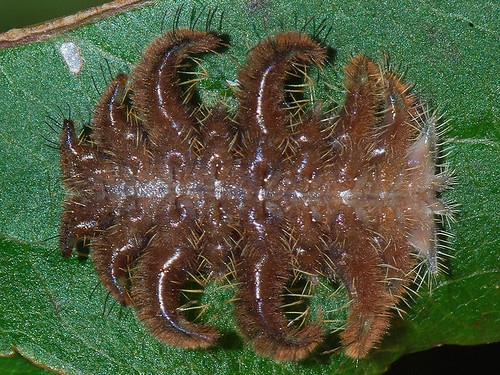
又發現不明生物非常噁心?- 刺蛾幼蟲啦

這是最近在網路上流傳的一段影片 (網路上反正什麼都會流傳), 其實是新熱帶區產的刺蛾科Phobetron屬的幼蟲. 那些怪怪的結構則是幼蟲的SD與L瘤突.

圖片連結: Nature NM的flickr相簿

2009年4月17日 星期五

起源自安地斯山之透翅蛺蝶的物種多樣化格局

Out of the Andes: patterns of diversification in clearwing butterflies
Full text: PDF
Molecular Ecology (2009) 18, 1716–1729

M. ELIAS,*†‡ M. JORON,†§ K. WILLMOTT,¶ K. L . SILVA-BRANDÃO,**,†† V. KAISER,† C. F. ARIAS,‡‡ L. M. GOMEZ PIÑEREZ,§§ S . URIBE,§§ A. V. Z. BROWER,¶¶ A. V. L. FREITAS** and C . D. JIGGINS‡

安地斯山的熱帶森林擁有全球生物多樣性的高峰,其令人矚目的地理特色似乎可提供促進產生生物多樣性的機會,如地理割據與生態上的種化。然而,對於占生物多樣性最多比例的昆蟲,這些山脈所扮演的角色仍很少被使用親緣關係方法進行研究。作者在本文中探討安地斯山在新熱帶區高多樣性的昆蟲- 蛉蛺蝶亞科(the clearwing butterflies)演化上扮演的角色。作者使用定年的種級親緣關係去評估發生種化的年代以及推測兩個多樣化的屬的祖先分布海拔範圍。結果顯示兩個屬可能都起源自第三紀中新世中期的安地斯山中海拔地區,與對脊椎動物發表的研究成果大多起源自低海拔相反。儘管作者偵測到由上新世-中新世之間安地斯山脈隆起所造成的割據種化訊號,大多數的姊妹種都是鄰域分布且沒有明顯的地理屏障。結合整體上趨緩的種化速率,此結果推測生態上的種化與適應性輻射所扮演的角色比單純的地理割據更為重要。

Abstract
Global biodiversity peaks in the tropical forests of the Andes, a striking geological feature that has likely been instrumental in generating biodiversity by providing opportunities for both vicariant and ecological speciation. However, the role of these mountains in the diversification of insects, which dominate biodiversity, has been poorly explored using phylogenetic methods. Here we study the role of the Andes in the evolution of a diverse Neotropical insect group, the clearwing butterflies. We used dated species-level phylogenies to investigate the time course of speciation and to infer ancestral elevation ranges for two diverse genera. We show that both genera likely originated at middle elevations in the Andes in the Middle Miocene, contrasting with most published results in vertebrates that point to a lowland origin. Although we detected a signature of vicariance caused by the uplift of the Andes at the Miocene–Pliocene boundary, most sister species were parapatric without any obvious vicariant barrier. Combined with an overall decelerating speciation rate, these results suggest an important role for ecological speciation and adaptive radiation, rather than simple vicariance.

2009年2月2日 星期一

大象對蝴蝶:大型草食動物在兩個熱帶世界的演化歷史所扮演的生態角色

Elephants versus butterflies: the ecological role of large herbivores in the evolutionary history of two tropical worlds Journal of Biogeography 30(9):1357–1380

| Full Text: HTML, PDF (Size: 222K)
Cris Cristoffer1* and Carlos A. Peres2 1CES/CEVN, Luke Air Force Base, AZ, USA, 2Centre for Ecology, Evolution & Conservation, University of East Anglia, Norwich, UK

本文分析已發表的資訊與個人通訊,試圖探討新熱帶與舊熱帶區兩者的草食性動物相存在明顯差異的原因。與新熱帶區相比,舊熱帶區擁有較多生物量的大型草食性動物,原因與具有較低多樣性的小型草食性動物、不同的原住民狩獵方式、較大的樹棲性脊椎動物、較大的果實、花與果的時空分布情形或其他因素有關。本文結果並不支持新熱帶區雨林在前全新世曾經存在過種類豐富的大型草食動物之說法。作者也不認為兩個熱帶區的動物相差異導因於在新世界區人類活動造成的動物滅絕。

Abstract
Aim
Large herbivores have important effects upon Paleotropical ecosystems, but attain much lower biomass densities in the Neotropics. We assess how this difference in herbivore activity has generated different ecological and evolutionary trajectories in the New and Old World tropics. We also propose an explanation for how the greater biomass density in the Old World came about.
Location
Data were compiled primarily from moist tropical forests, although more of the relevant information to address most of our hypotheses was available from the mainland areas of Africa, Asia, and South America than elsewhere.
Methods
We gleaned data from published information and personal communication. We compared body masses and a variety of other types of information for the New- and Old-World tropics. We proposed that interhemispheric differences exist in a variety of processes, including herbivory, frugivory, and flower visitation. We erected hypotheses and evaluated them qualitatively, and, when information was available, tested them using simple ratios of species in various taxonomic and trophic categories. To make the comparisons more meaningful, we specified appropriate data selection criteria.
Results
A general pattern of differences emerges from this review. Compared with Neotropical forests, the much greater biomass densities of large herbivores in Paleotropical forests are associated with a lesser diversity of small herbivores, different hunting methods used by indigenous humans, larger arboreal vertebrates, larger fruits, different patterns of fruit and flower dispersion in space and time, a lesser abundance of most types of reproductive plant parts, and other features. The existence of a species-rich fauna of large herbivores in the pre-Holocene Neotropical rain forest was not supported.
Main conclusions
The potential for large herbivores to cause functional differences between the New and Old World tropical forests has been virtually unexplored, despite the well-known importance of large herbivores in the Old World tropics. The evaluations of our hypotheses suggest that the abundance of large herbivores in the Old World tropics has launched it onto a different evolutionary trajectory than that of the NewWorld tropics. The relevant evidence, although scanty, suggests that the interhemispheric ecological differences are not an artefact of recent megafaunal extinctions in the New World. Recent human activities have, however, reduced population sizes of large wild herbivores in the Old World, and increased population sizes of livestock. This has likely created a rather homogeneous, anthropogenic selection pressure that tends to erase the evolutionary differences between the two tropical worlds.