2011年8月28日 星期日

全球毒蛾屬之生命條碼建構以及台灣類群之分類修訂與討論

文獻來源:deWaard JR, Mitchell A, Keena MA, Gopurenko D, Boykin LM, et al. (2010) Towards a Global Barcode Library for Lymantria (Lepidoptera: Lymantriinae) Tussock Moths of Biosecurity Concern. PLoS ONE 5(12): e14280. doi:10.1371/journal.pone.0014280 [連結]


簡介

毒蛾屬(Lymantria)為裳蛾科(Erebidae)毒蛾亞科(Lymantriinae)之毒蛾族(Lymantriini)物種數約170種的類群,物種多樣性集中於亞洲地區。由於此屬有不少種類具有幼蟲雜食性、大發生造成森林經濟危害,例如原產歐洲的吉普賽毒蛾(L. dispar)於1868/1869引入北美使其森林之危害以及台灣黑角舞蛾(木毒蛾)(L. xylina)對闊葉林、果樹林甚至木麻黃防風林之危害,故此篇文章針對部份東亞毒蛾屬類群以及不同的地區之吉普賽毒蛾進行分子生命條碼(molecular bacode)之建置與親緣分析。

此篇文章在材料上選取36種518個個體作為樣本,取其粒腺體COI生命條碼序列做親緣分析,獲得高支持度的物種歸群,因此有助於未來森林管理單位從事毒蛾屬大發生或是境外移入之物種快速鑑定作業。

此篇文章亦涵蓋台灣物種的取樣,針對分子親緣重建的結果進行分類處理(於此文章當中之附檔一),以下介紹該處理結果,並綜合近期主要毒蛾屬文獻作討論:

1. Lymantria nebulosa視為獨立於L. sinica之物種,兼論相關類群之誤鑑定

Lymantria nebulosa為Wileman (1910)所發表的台灣新種(模式產地台南關仔嶺),此種在Schintlmeister (2004)當中視為L. sinica之同物異名,Pogue (2007)延續此處理。此篇文章將L. nebulosa視為獨立種,所依據者為中國武夷山產之標本,該單一樣本於分子親緣關係樹中與兩隻台灣產被鑑定為L. sinica之樣本成為一單系群,此枝系再與另一香港產L. sinica成為姊妹群。此分類處理(將L. nebulosa視為獨立於L. sinica之有效種)與分子結果(L. sinica為駢系群)的資訊並不一致,作者認為原因可能有(1) COI生命條碼無法區別此兩物種; (2) 所選取之各地L. sinica樣本有可能有鑑定錯誤或是包含了未描述種之可能; 或是(3) 隨兩物種分歧時伴隨L. sinica之COI多型性之發生。然而此分類處理仍有待釐清者為 (1) L. nebulosa之模式產地為台灣,為何僅選取中國武夷山產個體作此學名的地位恢復(status revived)? (2) 分子親緣重建之樣本少且無樹型支持度,卻仍進行分類處理?(3) 缺乏型態證據的討論。

此外,在Schintlmeister (2004)的文章將影像(Fig. 417)鑑定為L. sinica雄蟲,然而此標本應為當時的未描述種。Pogue (2007)描述一台灣產新種L. pulverea,並指定兩隻花蓮大禹嶺七月採之雄蟲為正模與副模式標本,以及一筆五月採自宜蘭福山植物園之雄蟲作為另一隻副模標本,而大禹嶺產雄蟲之生殖器繪於圖板14-4。Pogue在其圖板3-7收錄了該福山副模而無大禹嶺產之成蟲標本影像,然此福山標本影像應是L紋褐毒蛾 Lymantria grisea kosemponis Strand, 1914雄蟲之誤鑑定。以上描述可知我們並無L. pulverea之大禹嶺標本影像作進一步評斷,直到上個月個人解剖科博館一筆毒蛾屬標本才釐清此物種隻標本鑑定,另此種之雌蟲尚未被描述。

Lymantria pulverea Pogue, 2007 (國立台中科學博物館館藏)

2. 波斑毒蛾 Lymantria mathura subpallida Okano, 1959被處理為獨立於原名種L. mathura外之獨立種,現用組合名為L. subpallida

在Schintlmeister (2004)文章中,其描述台灣產L. mathura之外部顏色斑紋變異甚大,並認為主要出自南部族群的標本偏向原名亞種L. m. mathura,而以北部為主的族群標本偏向日本亞種L. m. aurora,因此將台灣產L. m. subpallida視為aurora之次同物異名。此篇文章似乎忽略Schintlmeister之處理,選取過去認知的L. m. subpallida 3隻樣本(2隻台灣1隻香港產),於COI親緣關係樹上明顯與產於俄羅斯、韓國、日本之L. mathura分群(L. mathura與日本沖繩之L. flavida形成最近姊妹群),此結果初步支持此篇文章的分類處理,然亦如第1項分類處理般缺乏形態資訊。

3. 未來待釐清的L. minomonis/ L. sugii分類問題

台灣產之毒蛾亞屬(subgenus Lymantria)包含有低中高海拔夏季常見的絡毒蛾L. concolor以及另一物種,該物種由Kishida (1986)描述為L. minomonis之台灣特有亞種(模式產地桃源復興巴陵),另一亞種產於沖繩為L. m. okinawaensis Kishida, 1987。Schitlmeister (2004)認為L. minomonis除了由Kishida描述與原名種之雄蟲生殖器之間有些為差異,兩族群之雌蟲生殖器更能夠作為分類依據,他更認為L. minomonis sugii與印度、越南以及中國產之L. similis更接近,綜此將此族群視為獨立種L. sugii。Pogue (2007)將沖繩亞種名直接處理為原名種(minomonis)之次同物異名,並紀錄L. minomonis產於台灣,卻忽略了Kishida的L. sugii處理。此篇文章選取了日本本州山梨縣的一隻L. minomonis樣本,分子親緣與同亞屬的L. monacha (L. 1758)(58隻樣本)支系成為姊妹群,此樣本序列可在未來與台灣產L. sugii/minomonis作比較釐清分類問題。

Lymantria minomonis Matsumura, 1933/sugii Kishida, 1986 (左雄蟲; 右雌蟲)

4. 台灣產毒蛾屬後續研究
台灣目前已記錄毒蛾屬8種,仍有約3~4個新紀錄/新種尚待處理,期待未來能有更具系統性的處理。

Abstract

Background: Detecting and controlling the movements of invasive species, such as insect pests, relies upon rapid and accurate species identification in order to initiate containment procedures by the appropriate authorities. Many species in the tussock moth genus Lymantria are significant forestry pests, including the gypsy moth Lymantria dispar L., and consequently have been a focus for the development of molecular diagnostic tools to assist in identifying species and source populations. In this study we expand the taxonomic and geographic coverage of the DNA barcode reference library, and further test the utility of this diagnostic method, both for species/subspecies assignment and for determination of geographic provenance of populations.

Methodology/Principal Findings: Cytochrome oxidase I (COI) barcodes were obtained from 518 individuals and 36 species of Lymantria, including sequences assembled and generated from previous studies, vouchered material in public collections, and intercepted specimens obtained from surveillance programs in Canada. A maximum likelihood tree was constructed, revealing high bootstrap support for 90% of species clusters. Bayesian species assignment was also tested, and resulted in correct assignment to species and subspecies in all instances. The performance of barcoding was also compared against the commonly employed NB restriction digest system (also based on COI); while the latter is informative for discriminating gypsy moth subspecies, COI barcode sequences provide greater resolution and generality by encompassing a greater number of haplotypes across all Lymantria species, none shared between species.

Conclusions/Significance: This study demonstrates the efficacy of DNA barcodes for diagnosing species of Lymantria and reinforces the view that the approach is an under-utilized resource with substantial potential for biosecurity and surveillance. Biomonitoring agencies currently employing the NB restriction digest system would gather more information by transitioning to the use of DNA barcoding, a change which could be made relatively seamlessly as the same gene region underlies both protocols.

2011年8月16日 星期二

根據現生物種的地理分布資訊, 對寒冷氣候的耐受性及其在分子親緣關係架構中的保守性推測藍灰蝶起源於亞洲大陸並經由白令陸橋播遷至新世界

文獻來源: Vila R, Bell CD, Macniven R, Goldman-Huertas B, Ree RH, Marshall CR, Bálint Z, Johnson K, Benyamini D, Pierce NE. 2011. Phylogeny and palaeoecology of Polyommatus blue butterflies show Beringia was a climate-regulated gateway to the New World. Proceedings of the Royal Society B 278(1719): 2737-2744. [link]

Abstract
Transcontinental dispersals by organisms usually represent improbable events that constitute a major challenge for biogeographers. By integrating molecular phylogeny, historical biogeography and palaeoecology, we test a bold hypothesis proposed by Vladimir Nabokov regarding the origin of Neotropical Polyommatus blue butterflies, and show that Beringia has served as a biological corridor for the dispersal of these insects from Asia into the New World. We present a novel method to estimate ancestral temperature tolerances using distribution range limits of extant organisms, and find that climatic conditions in Beringia acted as a decisive filter in determining which taxa crossed into the New World during five separate invasions over the past 11 Myr. Our results reveal a marked effect of the Miocene–Pleistocene global cooling, and demonstrate that palaeoclimatic conditions left a strong signal on the ecology of present-day taxa in the New World. The phylogenetic conservatism in thermal tolerances that we have identified may permit the reconstruction of the palaeoecology of ancestral organisms, especially mobile taxa that can easily escape from hostile environments rather than adapt to them.

2011年8月14日 星期日

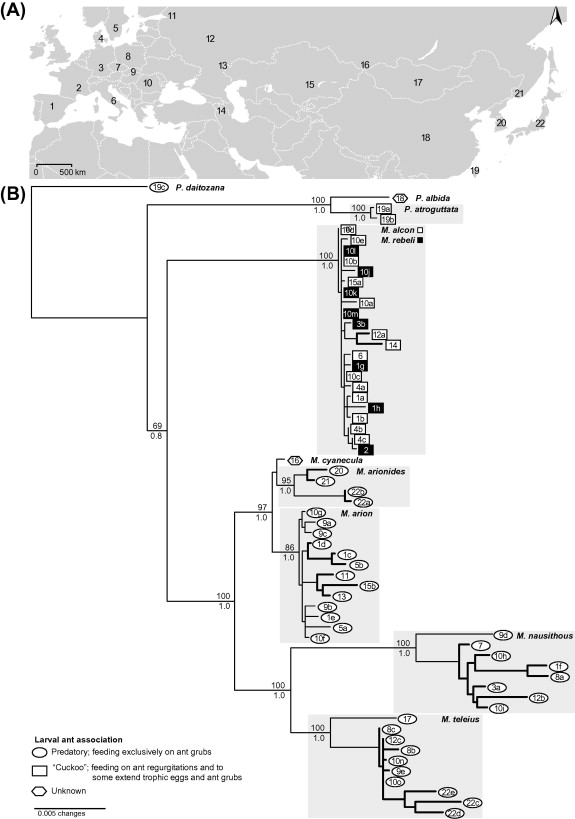
使用四個核基因與兩個粒線體DNA序列重建藍灰蝶節親緣關係時發現大藍灰蝶(Maculinea)的單系性的確因雀斑灰蝶(Phengaris)的插入而不復存在, 而稀有的碇灰蝶(Caeruelea)則為其姐妹群

文獻來源: Ugelvig LV, Vila R, Pierce NE, Nash DR. 2011. A phylogenetic revision of the Glaucopsyche section (Lepidoptera: Lycaenidae), with special focus on the Phengaris–Maculinea clade. Molecular Phylogenetics and Evolution 61(1): 237-243.

Abstract
Despite much research on the socially parasitic large blue butterflies (genus Maculinea) in the past 40 years, their relationship to their closest relatives, Phengaris, is controversial and the relationships among the remaining genera in the Glaucopsyche section are largely unresolved. The evolutionary history of this butterfly section is particularly important to understand the evolution of life history diversity connected to food-plant and host-ant associations in the larval stage. In the present study, we use a combination of four nuclear and two mitochondrial genes to reconstruct the phylogeny of the Glaucopsyche section, and in particular, to study the relationships among and within the Phengaris–Maculinea species.
We find a clear pattern between the clades recovered in the Glaucopsyche section phylogeny and their food-plant associations, with only the Phengaris–Maculinea clade utilising more than one plant family. Maculinea is, for the first time, recovered with strong support as a monophyletic group nested within Phengaris, with the closest relative being the rare genus Caerulea. The genus Glaucopsyche is polyphyletic, including the genera Sinia and Iolana. Interestingly, we find evidence for additional potential cryptic species within the highly endangered Maculinea, which has long been suspected from morphological, ecological and molecular studies.

2011年8月1日 星期一

即始一個分類群的生命條碼庫尚未被完全建置, 若一個樣本的屬級歸屬可以被確認, 那麼使用COI序列仍然可將其放置到正確的高階分類群中

文獻來源: Wilson JJ, Rougerie R, Schonfeld J, Janzen DH, Hallwachs W, Hajibabaei M, Kitching IJ, Haxaire J, Hebert PDN. 2011. When species matches are unavailable are DNA barcodes correctly assigned to higher taxa? An assessment using sphingid moths. BMC Ecology 11: 18 doi:10.1186/1472-6785-11-18.

Background
When a specimen belongs to a species not yet represented in DNA barcode reference libraries there is disagreement over the effectiveness of using sequence comparisons to assign the query accurately to a higher taxon. Library completeness and the assignment criteria used have been proposed as critical factors affecting the accuracy of such assignments but have not been thoroughly investigated. We explored the accuracy of assignments to genus, tribe and subfamily in the Sphingidae, using the almost complete global DNA barcode reference library (1095 species) available for this family. Costa Rican sphingids (118 species), a well-documented, diverse subset of the family, with each of the tribes and subfamilies represented were used as queries. We simulated libraries with different levels of completeness (10-100% of the available species), and recorded assignments (positive or ambiguous) and their accuracy (true or false) under six criteria.

Results A liberal tree-based criterion assigned 83% of queries accurately to genus, 74% to tribe and 90% to subfamily, compared to a strict tree-based criterion, which assigned 75% of queries accurately to genus, 66% to tribe and 84% to subfamily, with a library containing 100% of available species (but excluding the species of the query). The greater number of true positives delivered by more relaxed criteria was negatively balanced by the occurrence of more false positives. This effect was most sharply observed with libraries of the lowest completeness where, for example at the genus level, 32% of assignments were false positives with the liberal criterion versus <1% when using the strict. We observed little difference (<8% using the liberal criterion) however, in the overall accuracy of the assignments between the lowest and highest levels of library completeness at the tribe and subfamily level.

Conclusions
Our results suggest that when using a strict tree-based criterion for higher taxon assignment with DNA barcodes, the likelihood of assigning a query a genus name incorrectly is very low, if a genus name is provided it has a high likelihood of being accurate, and if no genus match is available the query can nevertheless be assigned to a subfamily with high accuracy regardless of library completeness. DNA barcoding often correctly assigned sphingid moths to higher taxa when species matches were unavailable, suggesting that barcode reference libraries can be useful for higher taxon assignments long before they achieve complete species coverage.

2011年7月25日 星期一

社會性毛蟲倒底要由誰揪團去那吃東西並非因為角色的分化, 而是因為帶頭的蟲肚子餓了

文獻來源:McClure M, Ralph M & Despland E (2011) Group leadership depends on energetic state in a nomadic collective foraging caterpillar. Behavioral Ecology and Sociobiology 65:1573-1579.

簡介
社會性動物之集體行動可以為多數個體帶來利益,但誰要冒著較大的風險領隊出發?誰要決定對的出發時機和移動方向?在某些動物中這些決策是由團隊共同決定,有些則是由部分或單一個體來決定的。此篇研究探討在Malacosoma disstria枯葉蛾幼蟲的集體掠食行為中,是由哪隻幼蟲佔據領導位置率先出發。研究分成兩個實驗,一是探討是否有些幼蟲特別容易產生這種領導掠食行為,另一則是控制幼蟲的能量攝取,看幼蟲的飢餓程度是否與領導掠食行為有關。實驗結果顯示,在相同的食物控制下,幼蟲的齡期、重量及性別皆與領導掠食行為無顯著關係,顯示此實驗中所有幼蟲之領導傾向沒有顯著差異;另一方面,在有能量(食草)控制的情況下,能量儲存量較低(較飢餓)的幼蟲有較高的傾向領導團隊展開掠食活動,且具有飢餓幼蟲之團隊會越快決定出發,但實豪儦F食物的時間則會視團隊中所有個體之飢餓程度而定,一團隊中若具有較多飢餓之個體,其集體行動之凝結力會降低,反而減緩到達目的地之速度。

Abstract
Group living is a common strategy among animals and has arisen independently in over 300 species of Lepidoptera. Yet, activity synchrony between individuals is necessary to derive the benefits that ensue from an aggregated lifestyle. Which individuals decide which activities to perform and when to perform them is, therefore, a fundamental question. In some species of social caterpillars and sawflies, the role of a potential behavioral polyethism between individuals has been suggested, whereby certain individuals are consistently more likely to initiate and lead a foraging event. However, in these cases, evidence in support of division of labor is lacking. This study was undertaken to determine if certain individuals of Malacosoma disstria are more likely to be consistent group leaders or if transient leaders could be predicted by the differences in energetic states between individuals. The results of this study indicate that unfed caterpillars initiate foraging bouts and are more likely to lead locomotion. There was no size or sex-based bias in those individuals that acted as temporary leaders. Consistent behavioral differences between individuals, if they exist, are therefore not necessary to explain task allocation and synchronization during foraging in this species.

2011年7月24日 星期日

婆羅洲蛾類誌最終回 - 榕蛾科, 帶翅蛾科, 斑蛾科與全系列包含物種之註釋名錄

文獻來源: Holloway, J.D. 2011. The Moths of Borneo: Families Phaudidae, Himantopteridae and Zygaenidae; revised and annotated checklist. Malayan Nature Journal 2011, 63(1-2): 1-548.

婆羅洲蛾類誌自1988年發表第一部燈蛾與擬燈蛾部份後, 到現在已經有18冊出版, 而這一冊也是整個系列的最後一本(聽起來真像哈利波特最後一集). 這個系列在過去出版的17冊中描述了婆羅洲與整個廣義的馬來亞區系的"大蛾類群"(註一), 只留下斑蛾總科的榕蛾科, 帶翅蛾科與斑蛾科這三個標本量稀少的類群尚未被搞定. 事實上Holloway自從1976年左右就已經開始針對Kinabalu山區的蛾類, 包含斑蛾科昆蟲進行分類學研究, 但是當時他尚未對整個馬來亞區的所有物種進行普查. 此外在這個厚達548頁的單行本中, 他也將過去所有冊數中所包含的物種的名錄, 以及這近23年來所有物種分類地位的變革加以整理, 使得這一冊的價值更為重要.

在斑蛾科的部份, Holloway進行以下的分類處理:
  • Cleoda屬二新種: 分別為Cleoda postvitrea以及C. flavipicta. 其中flavipicta在我2005年的論文中被視為Cleoda syntomoides的雄蟲.
  • Heteropan屬二新種: Heteropan leesi與H. hantu.
  • Agalope屬新亞種: Agalope glacialis postfasciata
  • Trypanophora屬一新種: Trypanophora potens
  • Psaphis屬一新種Psaphis endoi以及Psaphis resumpta的復活使用
  • Boradiopsis屬兩新種B. harmani與B. cheyi以及一新組合Boradiopsis bipartita.
在全系列回顧方面, Holloway採用2011年即將在Zootaxa發表的全新鱗翅目科級分類系統重新整理過去所有涵括物種的分類現況. 而這高達4630個物種的分類變更則將分別介紹.

此外有關馬來西亞自然學會未來是否會繼續出版蛾類專書一事, 目前尚沒有聽到確實的消息, 不過自三年前起該學會已經與德國柏林自然史博物館的學者接洽處理螟蛾總科的專書, 若該書確實已達策畫與執行的階段則是非常令人期待的.

註一: 所謂的"大蛾"(macromoths)其實只是一個不正式的名詞, 用以描述一般人認為"比較大隻的蛾", 但這個名詞在科學上是沒有意義的.

2011年7月19日 星期二

利用植物標本館檔案及老DNA片段追蹤歐洲入侵性植食者- 七葉樹潛蛾的入侵起源

資料來源: DC Lees, HW Lack, R Rougerie, A Hernandez-Lopez, T Raus, ND Avtzis, S Augustin & Lopez-Vaamonde. 2011. Tracking origins of invasive herbivores through herbaria and archival DNA: the case of the horse-chestnut leaf miner. Frontiers in Ecology and the Environment doi:10.1890/100098

簡介
七葉樹潛蛾(Cameraria ohridella)1986年首度在歐洲被描述之後,在歐洲成為一個擴散路徑和起源地具有爭議性的入侵物種,2009年8月在本部落格曾介紹過下列文章: 粒線體與微衛星體DNA標記顯示具高入侵性的七葉樹潛蛾起源自巴爾幹半島,該文章報導此種潛蛾的COI單體型‭ (‬haplotype‭)‬(不計入觀賞用樹木上者)多為特有型或是侷限分布,唯有單體型A是廣泛優勢的,不僅遍佈全歐洲而且在巴爾幹半島殘餘的七葉樹族群分布地點上也能找到此型。故「此種潛蛾為何是在最近40年才從巴爾幹半島擴張出去?又是如何擴散到其它地方?」仍然未清楚,而單體型A為何會在擴及歐洲各地的七葉樹潛蛾COI遺傳組成中占優勢則成為本研究想要探討的問題,作者提出兩個假說‭ ‬H0‭:‬‭ ‬單體型A在歷史空間上原本就是廣布,且在自然組群中占優勢,因此就有較高的機率隨著景觀植物的種植被散播出去,H1‭: ‬過去的歷史中單體型A和其他單體型一樣稀少而且局限分布在巴爾幹半島,直到晚近才變得具有入侵性,甚至入侵到殘存的天然七葉樹族群中。

2011年6月此研究團隊利用植物標本館內寄主植物的館藏獲得這些潛蛾的歷史分布資料,‭ ‬最早可追溯自1879年採集自希臘中部的天然族群之標本,‭ ‬可作為推測此蛾擴散年代之參考,也由於歷史標本的各野生採集地非常難以到達,作者認為現代道路系統的發展是促成潛蛾擴散的原因,因為快速的汽車交通能在無意中將落葉中的幼蟲和渡冬蛹運送到另外一的個地點。

從標本檔案的葉片內留存的幼蟲或蛹的乾燥樣本可用統計受感染趨勢,甚至從這些樣本中擴增出短片段的核DNA與粒線體DNA作為遺傳單體型分析以族群遺傳學方式判斷擴散起源,這些檔案序列不僅確認了C‭.‬‭ ‬ohridella的身分更把其在歐洲的歷史回溯至少100年,雖然作者的結果無法充分的排除H0但是較支持他的‭ ‬H1,即單型體A是在1970年間道路系統發展後才擴散到其它地區的。本文強調植物標本館的重要性長期受到忽略,本研究的結果顯示研究入侵物種的擴散歷史和原因時,少數的植物標本館是唯一能追蹤過去空間歷史的僅存資訊,並能提供優質的資源得到接近真實的推測,提供入侵種管理策略之參考。

Abstract
Determining the native geographic range or origin of alien invasive species is crucial to developing invasive species management strategies. However, the necessary historical dimension is often lacking. The origin of the highly invasive horse-chestnut leaf-mining moth Cameraria ohridella has been controversial since the insect was first described in 1986 in Europe. Here, we reveal that herbarium collections across Europe indicate a Balkan origin for C ohridella. We successfully amplified nuclear DNA and mitochondrial DNA barcode fragments from larvae pressed within leaves of herbarium samples collected as early as 1879. These archival sequences confirm an identity of C ohridella and set back its history in Europe by more than a century. The herbarium samples uncovered previously unknown mitochondrial haplotypes and locally undocumented alleles, showing local outbreaks of C ohridella back to at least 1961 and dynamic frequency changes that may be associated with road development. This case history demonstrates that herbaria are greatly underutilized in studies of insect–plant interactions, herbivore biodiversity, and invasive species’ origins.


更多相關資訊
doi:10.1890/100098 – zum Artikel (Full text available via http://dx.doi.org)
www.bgbm.org/bgbm/pr/Archiv/pressimages/press_images.HTM#Miniermotte – for press photos
http://eolspecies.lifedesks.org/pages/8675 – about the horse-chestnut leaf miner