哪些資料支持新連結網絡演化的存在? 為了將兩個相似的基因網絡認定為非同源(nonhomologous),在以作者提出的骨架檢驗其基因網絡連結細節之前,重要的是先確認它們的相似是來自於直向同源(orthologous) 而不是旁系同源(paralogous)、且基因之間相同功能適當連結連結。以眼睛的發育網絡舉例,其某些組成的基因不符合上列原則,可能是這些基因在不同的支系以全新的方式連結。比較昆蟲與脊椎動物的眼睛發育網絡,即便其中某些基因是相似的,但是某些基因並非orthologous而是paralogous copies,且兩者功能上的關係是不同的。此例比較不同生物間的基因網絡而非同一個個體之內,但核心問題是一樣的:這兩種不同的眼睛發育網絡是否來自於同一個祖先? 由於這些旁系同源基因(sine oculis in Drosophila, and Six3 and Optx2 in Xenopus)早在昆蟲與脊椎動物分化之前即已存在,假設它們在各自的支系中發展出眼睛發育網絡,或假設這兩份copies如副本般保存、且長期冗贅地表現眼睛基因直到在各自的支系中被壓制,前者會比後者更儉約。 多效性CREs有何演化上的暗示? 生物學家對於何種基因改變對於適應性演化變異最有影響存有爭議,主要被認為會發生改變的兩個位置為調節DNA與蛋白質編碼DNA,爭議的中心為那個位置遭受最少量的多效性(pleiotropy)。支持non-coding DNA region的人認為模組化的CREs允許基因發展出新的功能且不至於减損就有的功能,因為不需要發生蛋白質序列上的改變。但是現有的證據顯示,蛋白質(包括Hox proteins)本身高度地模組化,亦即蛋白質的不同部位可與不同的co-factors結合,而蛋白質的修改也許會影響其中一種功能、但並非同時影響所有功能。作者認為討論蛋白質或調節序列何者對適應性演化有較大的作用,或許太過簡化甚至可能誤導,這兩者都可以模組化且具多效性,故討論應該轉而著重於是否模組化的網絡在發育系統中是常見的、網絡的大小、基因網絡的co-option在建構基因的調解區域時扮演何種角色。另一個重點是,CREs包含了許多型的轉錄因子結合區域,可調節位在同一個空間區域中基因或對同一個環境刺激作出反應。 關於解答 對於完全了解新特徵如何演化出來仍有待努力,作者在本文提出一個試驗性的骨架供測試新的特徵是否由已經存在的基因網絡中演化而來。為解答此問題,必須持續探索還有哪些基因在不同的特徵上有作用、以鑑定出那些作用類似整合或脈絡不敏感的基因網絡,這些基因的CREs應該在橫跨不同發育脈絡的多個表現區域上進行測試。如果同一個CRE驅使基因表現在不同的結構上,網絡重新增補便是最可能的機制;假如並非如此,則此網絡連結可能是全新打造的了。
PLoS ONE 3(3): e1736 Douglas J. Blackiston, Elena Silva Casey, Martha R. Weiss* Department of Biology, Georgetown University, Washington, D. C., United States of America
本研究以Y型路徑選擇裝置進行行為實驗,實驗組幼蟲先以條件制約方式使五齡幼蟲學習到把乙酸乙酯 (EA, Ethyl Acetate)的氣味與溫和的電極聯想在一起,結果顯示未接受過電極或只單純受過電極的幼蟲,對於EA的氣味並沒有偏好或厭惡的選擇,但是曾同時受過EA+電極八次的五齡幼蟲,則明顯地表現出厭惡EA氣味的選擇,且此選擇直到羽化為成蟲仍然保持。若以三齡幼蟲進行EA+電極配對實驗,結果直到五齡幼蟲時仍能表現出對EA厭惡的選擇,但是經過變態為成蟲之後則對EA沒有顯著的厭惡表現了。至於蛹期所接觸的環境中化學物質則並未改變成蟲的選擇偏好:對未經實驗處理的蛹施以EA氣味,其羽化成蟲對EA或新鮮空氣的選擇沒有顯著差異,而已對幼蟲施予EA+電極配對實驗後的蛹雖經過洗滌,其羽化成蟲仍然厭惡EA氣味。 Abstract Insects that undergo complete metamorphosis experience enormous changes in both morphology and lifestyle. The current study examines whether larval experience can persist through pupation into adulthood in Lepidoptera, and assesses two possible mechanisms that could underlie such behavior: exposure of emerging adults to chemicals from the larval environment, or associative learning transferred to adulthood via maintenance of intact synaptic connections. Fifth instar Manduca sexta caterpillars received an electrical shock associatively paired with a specific odor in order to create a conditioned odor aversion, and were assayed for learning in a Y choice apparatus as larvae and again as adult moths. We show that larvae learned to avoid the training odor, and that this aversion was still present in the adults. The adult aversion did not result from carryover of chemicals from the larval environment, as neither applying odorants to naı¨ve pupae nor washing the pupae of trained caterpillars resulted in a change in behavior. In addition, we report that larvae trained at third instar still showed odor aversion after two molts, as fifth instars, but did not avoid the odor as adults, consistent with the idea that post-metamorphic recall involves regions of the brain that are not produced until later in larval development. The present study, the first to demonstrate conclusively that associative memory survives metamorphosis in Lepidoptera, provokes intriguing new questions about the organization and persistence of the central nervous system during metamorphosis. Our results have both ecological and evolutionary implications, as retention of memory through metamorphosis could influence host choice by polyphagous insects, shape habitat selection, and lead to eventual sympatric speciation.
McGuire Center for Lepidoptera and Biodiversity 兼具研究與大眾教育之功能,位在佛羅里達大學Gainesville校區,包括活生生的雨林與鱗翅目展覽場地、以及佔地39,000坪方英尺的研究實驗室與館藏空間,目前已經有系統地收藏超過400萬份標本,館藏規模僅次於擁有約870萬份鱗翅目標本的倫敦自然史博物館(Natural History Museum in London)。研究空間包括分子遺傳學、掃描式電子顯微鏡、影像分析、瀕危物種保育與圈養、光學顯微鏡和標本製備等空間,此外尚有教室與12間研究員、館藏經理與職員的辦公室,空間寬敞且明亮,許多著名的鱗翅學者如K. Willmott、J. Miller、J. Heppner等都在此中心任職。
這個中心另一個特別之處在於其經費來自龐大的私人捐款,2001年春天,正當許多自然史博物館正在縮小昆蟲部門的規模時,佛羅里達大學接獲一筆提供來興建世界上規模最大的蝴蝶與蛾類研究教育中心- McGuire Center for Lepidoptera-的捐款,預計在2003年完工並收藏至少六百萬份標本,成為美國最大的館藏之一。最初420萬美金的捐款是由聯合健康保險集團(UnitedHealth Group) 當時的總裁 Dr. William W. McGuire 與他的妻子Nadine M. McGuire所捐贈,這是美國的昆蟲系統學界獲贈過最大筆的私人捐款,佛羅里達州政府撥款提供一致的經費以完成這個計畫。 Dr. McGuire 是一位醫生,同時也是頗具造詣的業餘鱗翅學家,選擇佛羅里達大學的原因是當其他大學或機構都縮減收藏規模時,唯有佛羅里達大學持續擴展其收藏。據第一任也是現任館長 -鱗翅學者Dr. Thomas C. Emmel表示,該館與其他機構的另一個不同點在於其首要任務並非強調保育、氣候變遷或棲地喪失等議題,而是與其他國家取得研究當地生物多樣性的協議,許多較低開發的國家仰賴生物多樣性調查來使休耕田作為類似國家公園的保留區。
該館大多數的館藏來自原先屬於佛羅里達大學的大量卻散亂的收藏品,包括位在Sarasota的Allyn Museum of Entomology和位在Gainesville的Florida State Collection of Arthropods,其他的標本捐贈與收購預期會很快地使館藏超過600萬份標本,但是將會有二到三倍的空間足以因應未來數十年的收藏,約可擴增達2,000萬份。
目前的公開展場主要分成兩個部分:Butterfly Rainforest與Butterfly exhibit,前者是一個種植了熱帶與亞熱帶植物大花園,內有瀑布與步道,固定時間會釋放館方飼育的來自世界各地的蝴蝶,導覽遊客認識各種蝴蝶;後者生動的介紹鱗翅目相關的知識,最引人注目的是一大面由上萬隻鱗翅目標本與照片所組成的"Wall of Wings",還有來自世界各地的攝影畫面。 相關參考: Florida Museum of Natural History
McGuire Center News: McGuire Center Newsletter - April 2008, Issue 2
文獻來源: Yamamoto S, Sota T. 2007. Phylogeny of the Geometridae and the evolution of winter moths inferred from a simultaneous analysis of mitochondrial and nuclear genes. Molecular Phylogenetics and Evolution 44(2): 711-723. [全文連結]
Abstract Geometridae is one of the most diverse families within the Lepidoptera, comprising nine subfamilies. Winter moths, which have aunique life history, are found in three subfamilies. To examine the phylogeny of the Geometridae at the subfamily level and determine the evolutionary history of winter moths, we constructed phylogenetic trees for all nine geometrid subfamilies using two mitochondrialand two nuclear gene sequences. Specimens of all subfamilies were sampled from Japan. Simultaneous analyses of the combined datafrom all genes revealed that the Geometridae comprised two major clades: one with subfamilies Larentiinae and Sterrhinae, and the otherwith the remaining seven subfamilies. The second clade included the largest subfamily, Ennominae, and the subfamily Archiearinae,which is traditionally considered to be an ancestral lineage of the Geometridae. The Larentiinae + Sterrhinae clade contained one wintermoth lineage, and the second major clade consisted of three winter moth lineages, including Alsophilinae, which contains winter mothsexclusively. Using a Bayesian inference of divergence times, we estimated that geometrids began to diverge 54 Mya (62–48 Mya), whereaswinter moth lineages differentiated from non-winter moth lineages 34–12 Mya, during the global cooling events in the Oligocene and theearly Miocene. The adaptation to cool climates may have been a preadaptation that facilitated the winter moth life cycle.
過去冬尺蛾類群據形態分類學,被處理於3亞科12屬中,並認為冬尺蛾的出現是為了躲避天敵的捕食;此篇文章取樣了3亞科5屬7種,並與Abraham et al. (2001)皆證實冬尺蛾非單系群,而是獨立演化了至少四次;另此篇文章由分子鐘定年並配合地質年表與事件,推論冬尺蛾的演化源自晚秋自初春之間活動的尺蛾類群,而冬尺蛾的出現可能是由於地質史上的漸新世至中新世早期間,氣候轉趨寒冷的結果,然促進與維持冬尺蛾在僅在冬季活動的選汰作用尚不明。
Abraham, et al. (2001). Molecular phylogeny of the subfamilies in geometridae (Geometroidea : Lepidoptera). Molecular Phylogenetics and Evolution 20(1): 65-77.
Beljaev, E. A. (2006). A morphological approach to the Ennominae phylogeny (Lepidoptera, Geometridae). Spixiana 29(3): 215-216.
Holloway, J. D. (1996). The Moths of Borneo: Part 9; Family Geometridae, subfamily Oenochrominae, Desmobathrinae and Geometrinae. Malayan Nature Journal 49(3-4): 147-326.
Holloway, J. D. (1997). The Moths of Borneo: Part 12; Family Geometridae, subfamily Sterrhinae and Larentiinae. Malayan Nature Journal 51(1-4): 1-242.
Niitsu, S. (2001). Wing degeneration due to apoptosis in the female of the winter moth Nyssiodes lefuarius (Lepidoptera, Geometridae). Entomological Science 4(1): 1-7.
Sihvonen, P. (2005). Phylogeny and classification of the Scopulini moths (Lepidoptera : Geometridae, Sterrhinae). Zoological Journal of the Linnean Society 143(4): 473-530.
Sihvonen, P. and L. Kaila (2004). Phylogeny and tribal classification of Sterrhinae with emphasis on delimiting Scopulini (Lepidoptera : Geometridae). Systematic Entomology 29(3): 324-358.
Sihvonen, P. and M. Siljander (2005). Species diversity and geographical distribution of Scopulini moths (Lepidoptera : Geometridae, Sterrhinae) on a world-wide scale. Biodiversity and Conservation 14(3): 703-721.
Journal of Biogeography (J. Biogeogr.) (2009) 36: 337–349 Jan C. Axmacher1*, Gunnar Brehm2, Andreas Hemp3, Henry Tu¨nte4, Herbert V. M. Lyaruu5, Klaus Mu¨ller-Hohenstein4 and Konrad Fiedler 1UCL Department of Geography, University College London, London, UK, 2Institut fu¨r Spezielle Zoologie mit Phyletischem Museum, Friedrich-Schiller-Universita¨t Jena, Jena, 3Department of Plant Systematics, Universita¨t Bayreuth, Bayreuth, Germany, 4Department of Biogeography, Universita¨t Bayreuth, Bayreuth, Germany, 5Department of Botany, University of Dar es Salaam, Dar es Salaam, Tanzania and 6Department of Population Ecology, Vienna Ecology Centre, University of Vienna, Vienna, Austria
ABSTRACT Aim This study was conducted to investigate the potential of predicting alpha diversity and turnover rates of a highly diverse herbivorous insect family (Geometridae) based on vascular plant species richness and vegetation structure.
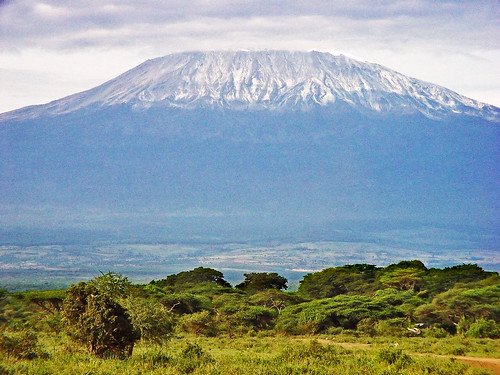
Location The study was carried out on the south-western slopes of Mount Kilimanjaro within a wide range of habitats between 1200 and 3150 m elevation. Methods The floristic and structural composition of the vegetation was recorded at 48 plots of 400 m2. Geometrid moths were sampled manually at light sources located at the plot centres. Principal components analysis, redundancy analysis and multiple linear regression were used to explore how alpha diversity and species turnover of geometrid moths are related to vegetation structure and plant species richness. Results Alpha diversity of geometrid moths was significantly correlated with species diversity patterns in the most common vascular plant families (R2 = 0.49) and with plant structural parameters (R2 = 0.22), but not with overall floristic diversity. Species turnover of geometrid moths was strongly linked to diversity changes in a range of plant families (40% explained variance), less strongly to changes in vegetation physiognomy (25%), and only weakly to overall floristic diversity (5%). Changes in elevation were a better predictor of both alpha diversity and species turnover of geometrid moths than any principal component extracted from the vegetation data. Main conclusions Vegetation composition, diversity and structure all showed significant correlations with the diversity and species composition of geometrid moth assemblages. Nevertheless, in most cases relationships were indirect, via environmental parameters such as temperature and humidity, which influenced both vegetation and moth fauna. Possible direct links between geometrid diversity and potential food plants were much weaker. The lack of a significant correlation between overall plant species richness and geometrid diversity indicates that tropical geometrid moths may not be very selective in their food plant choice. Accordingly, a clear correlation between floral diversity and herbivore species richness must be regarded as overly simplistic, and the diversity of vascular plants cannot universally be used as a suitable biodiversity indicator for diverse insect taxa at higher trophic levels.
Andreas Zwick a,b (2009) a Australian National Insect Collection, CSIRO Entomology, GPO Box 1700, Canberra, ACT 2601, Australia b School of Botany and Zoology, The Australian National University, Canberra, ACT, Australia
Abstract Male genital structures and muscles of bombycoid moths have repeatedly been misidentified in the literature. Furthermore, the genital structures of some bombycoid families, such as the poorly known Australo-New Guinean Anthelidae, have essentially remained unstudied. Based on comparative morphology, this study details the principal arrangements of male genital sclerites and muscles in all bombycoid families, with particular focus on basic structures and their modifications in Anthelidae. Emphasis is placed on the homology of and fusions between these structures and their function, providing a basis for the interpretation of modifications in future phylogenetic and taxonomic studies. This includes the unique fusion of gnathos and valvae in several bombycoid families, the arrangement and extent of the fused tegumen and vinculum, as well as the homology of the ‘‘transtilla’’. Further, a modification of the valve adductor muscle (the segment IX sternum to valva muscle, m4) widely regarded as a synapomorphy of Bombycoidea is demonstrated to be non-existent, as is the presumed presence of the valve abductor muscle (the segment IX tergum to valva muscle, m2) in Saturniidae.


 哪些資料支持CREs可作用在多個發育脈絡上?
 哪些資料支持新連結網絡演化的存在?
 哪些資料支持CREs可作用在多個發育脈絡上?
 哪些資料支持新連結網絡演化的存在?